Testbeds
Germany has a robust fiber link infrastructure for Quantum Communication. On this page, you can find existing or planned research setups of the QR.N project partners.
Within QR.N, testbeds are already available today where various Quantum Memories are tested and used for demonstrations and experiments. These connections enable the trial of new protocols, components, and procedures for Quantum Communication under real-world conditions. They thus provide an important foundation for gradually advancing the technologies toward future Quantum Networks.

Legend:
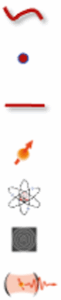
Fiber Testbed
Pair Source / Detector
Repeater Link in Laboratory
Diamond Quantum Memory
Atom / Ion Quantum Memory
SC Quantum Dot Emitter
Resonator-Integrated Memory
In addition to the existing fiber links, efforts are underway within the initiative to build a nationwide fiber network for Quantum Technologies and Time and Frequency signals (T&F) to establish an additional, limited fiber backbone separated from the regular internet. This network is intended to be available in the coming decade for research, development, and applications in the fields of Quantum Communication and T&F distribution – independent of the operational requirements of classical data communication.

Potential Future Quantum Networks over the QTF Backbone:
- Partners
- Testbeds
Testbeds:
- LMU-MPQ: In preparation, 29 km
- Ulm: In preparation
- Stuttgart: Entangled photons, 35 km
- KIT: In preparation, 22 km
- Saarbrücken: Memory-photon entanglement, 14 km
- LUH-PTB: Single photons, 73 km
- Paderborn: In preparation, 4 km
- Berlin: Various connections; entangled photons, 4–47 km
The testbeds operated within the joint project serve as practical platforms to test key components and procedures of Quantum Communication outside of protected laboratory conditions. Each of these links focuses on a specific technological aspect and contributes in different ways to the common goal: paving the way for stable, scalable Quantum Networks in Germany. Below, we present the testbeds in detail.
Saarbrücken Quantum Communication Fiber Testbed
As part of the research on distributed Quantum Networks, a 14.4 km urban dark fiber link has been established as an open testbed between the Universität des Saarlandes (UdS) and the Hochschule für Technik und Wirtschaft des Saarlandes (HTW saar).
On the UdS side, there are three specialized laboratories: one with a 40Ca+-ion-based Quantum Memory and an SPDC photon-pair source, each operating at a system wavelength of 854 nm; another with a Quantum Memory based on a tin-vacancy (SnV) center in diamond (619 nm); and a laboratory for frequency conversion of the respective photons to a common wavelength of 1550 nm (telecom C-band). A frequency comb system serves as a shared, highly stable frequency reference for all excitation and conversion lasers.
The fiber link to HTW runs partly above ground along high-voltage lines (1.2 km) and partly underground through several patch stations in Saarbrücken, with a total attenuation of approx. 11 dB. Two dark-fiber strands are available for experiments: one for Quantum Signals and the other for classical synchronization and control data. Alternatively, the two fibers can be combined into a 29 km ring.
At the HTW site, a server room houses all detection and stabilization equipment in a standard 19-inch rack. Superconducting nanowire single-photon detectors (SNSPDs) with single-photon detection efficiencies above 80 % are used.
Qubits can be encoded either in time-bin or polarization. The path-length drift critical for time-bin encoding is temperature-dependent and varies cyclically over the course of a day, with a maximum drift of 0.8 ns per day. To compensate for time-dependent polarization drifts, an active stabilization system is also used, ensuring average process fidelities ≥ 99 %.
Using this infrastructure, photon–photon and ion–photon entanglement generated with the SPDC source have already been distributed, and teleportation of a qubit state from the ion Quantum Memory to a remote telecom photon has been demonstrated. This testbed thus provides a practical infrastructure for Quantum Communication Experiments and enables comprehensive validation studies as well as investigations of system interoperability in an urban fiber environment.

Source reference: Kucera, S., Haen, C., Arenskötter, E. et al. Demonstration of quantum network protocols over a 14-km urban fiber link. npj Quantum Inf 10, 88 (2024). https://doi.org/10.1038/s41534-024-00886-x.
Stuttgart Quantum Communication Fiber Testbed
The Stuttgart Quantum Communication Fiber Testbed links multiple locations on the Universität Stuttgart Vaihingen campus with the Deutsche Telekom AG site in Feuerbach. The network forms a 35.8 km optical fiber loop, utilizing two dark fibers routed through the Stuttgart city center, with a total transmission loss of 14.4 dB.
Initial experiments have demonstrated the successful preservation of photon-polarization entanglement across the entire loop (DOI: 10.1364/OPTICAQ.530838), laying the foundation for future real-world Quantum Communication Deployments.

Reproduced from Strobel et al.,”High-fidelity distribution of triggered polarization-entangled telecom photons via a 36 km intra-city fiber network“, Optica Quantum 2, 274–281 (2024), lizenziert unter CC BY 4.0.
Karlsruhe Quantum Communication Fiber Testbed
At KIT, a testbed for Quantum Communication has been set up, connecting several laboratories at Campus South and Campus North. A pair of deployed dark fibers spanning a length of 22 km has been rented from a telecommunication provider therefore.
As a first step, Continuous Variable Quantum Key Distribution has been successfully demonstrated. The next phase comprises the transmission of frequency-converted single photons from color centers in diamond, and demonstrations of spin-photon and finally spin-spin entanglement across the link.

Berlin Quantum Communication Fiber Testbed
The Berlin DT R&D test network provides a comprehensive and actively operated infrastructure for research and development in Quantum Communication. It connects multiple locations in and around Berlin via underground single-mode fiber links, enabling realistic tests and demonstrations.
The central access point to the testbed is located in the Quantum Lab of T-Labs, the research unit of Deutsche Telekom AG, on Winterfeldtstraße in Berlin. This lab specializes in computing, network diagnostics, and automation, providing optimal conditions for experimental setups. On-site, various fiber loops, terminated fiber connections, and dedicated rack space for user systems are available. The controlled environment with a constant room temperature of 25 °C ensures stable and reproducible experimental conditions.
The link infrastructure supports a wide wavelength range from the O-band (1310 nm) to the C-band (1550 nm). Active fiber connections link several Berlin institutions:
- T-Labs – Französische Straße: approx. 10.4 km, 6 links / 12 fibers, SMF, ~2.8 dB
- T-Labs – Dottistraße: 13.8 km, SMF, ~4.5 dB
- T-Labs – Campus der Humboldt-Universität zu Berlin Adlershof: 25.7 km, 6 links / 12 fibers, SMF, ~8.9 dB
- T-Labs – ERP: 8.5 km, SMF, ~4.1 dB
- T-Labs – Fraunhofer Heinrich-Hertz-Institut: 4.4 km, 10 links / 20 fibers, SMF
- T-Labs – Strausberg: 47.3 km, 4 links / 8 fibers, SMF, ~14.5 dB
- T-Labs – Bundesdruckerei: 3.8 km, 6 links / 12 fibers, SMF
Additionally, connections spanning several hundred kilometers are available if needed, for example, to validate distributed systems or test Quantum Repeater Architectures.
This unique network infrastructure allows users from research and industry to test new systems and protocols in an urban, realistic environment.

Niedersachsen Quantum Link
The ‘Niedersachsen Quantum Link’ is a plug&plug testbed between Hanover and Braunschweig. The testbed consists of two underground single mode fibers, with one access point at the Leibniz Universität Hannover and the other at the Physikalisch-Technische Bundesanstalt (PTB) in Braunschweig. The optical distance between the two points is approximately 79 km.
One of the single mode fibers is currently used for the transmission of Quantum Signals with a loss of about 21.0 dB. The other is prepared for the transmission of time and frequency signals for the synchronization of the nodes on the testbed.
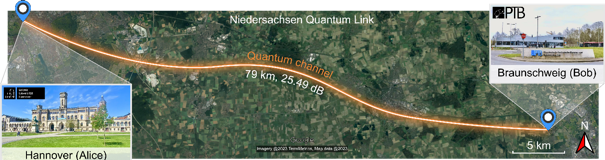
Source reference: Light Sci Appl 13, 150 (2024).
Ludwig-Maximilians-Universität München
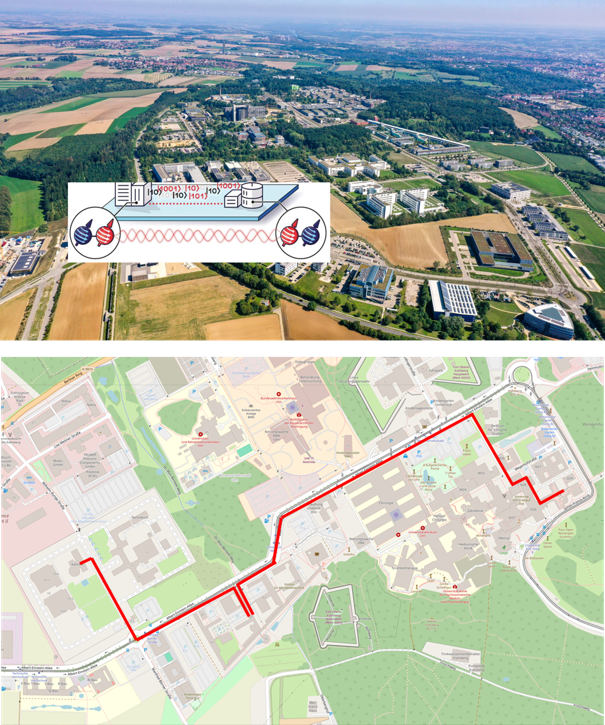
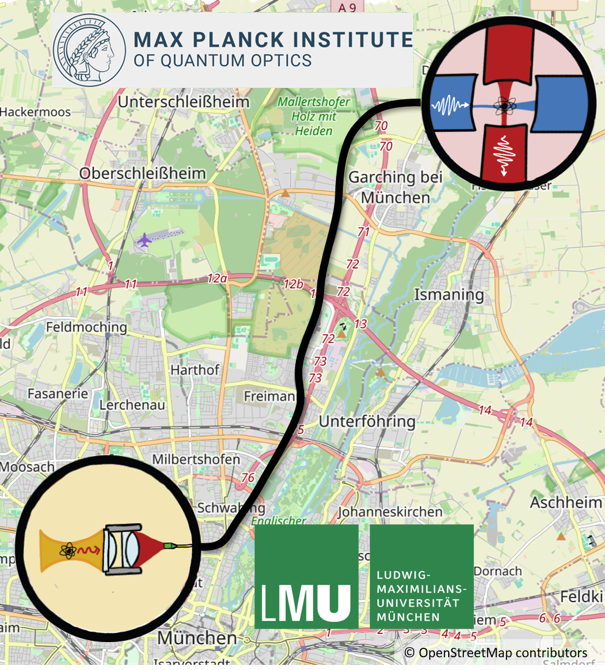
In a collaboration between the research groups of Prof. Dr. Gerhard Rempe at the Max-Planck-Institut für Quantenoptik and Prof. Dr. Harald Weinfurter at Ludwig-Maximilians-Universität, a Quantum Link is being established in the Munich metropolitan area. The plan is to exchange individual photonic qubits between two single atoms over a 23 km optical fiber. The entanglement of the photon with the emitting atom is to be transferred to the target atom, with successful entanglement between the two atoms heralded by the generation of an additional photon at the target. In subsequent experiments, the entanglement of the two atoms will then be available as a resource.
Ulm Quantum Communication Testbed
The Ulm Quantum Communication Testbed connects the scientific facilities on Ulm’s Eselsberg between the Universität Ulm, the University Hospital, and the Deutsche Zentrum für Luft- und Raumfahrt (DLR). An optical fiber connection to Ulm’s city center is in preparation for the expansion towards an urban Quantum Network. Initial tests based on commercial QKD systems have been carried out, with the focus on research and applications in computer science (IT security) and medicine. Basic research in physics is being expanded through the connection of Quantum Network and Quantum Repeater Nodes from academic research laboratories.