
Important Step for the Development for semiconductor-based Quantum Light Sources:
In recent years, Quantum Networks have emerged as a key research area. They promise improved security for critical infrastructures and pave the way for applications such as secure Quantum Computer Networking and the development of a Quantum Internet. Such a network relies on reliable Quantum Hardware: Quantum Memories that can store and retrieve Quantum Information, as well as Quantum Light Sources that emit at telecommunication wavelengths and produce deterministic, highly bright, and highly precise entangled photons.
A central component of such networks is Quantum Teleportation. It allows the Quantum State of one photon to be transferred to another, distant photon without directly measuring the underlying information. Against this backdrop, researchers from the QR.N consortium at the Stuttgart, Saarbrücken, and Dresden sites have now achieved an important milestone in the development of semiconductor-based Quantum Light Sources. The results were published in a new paper in mid-November.
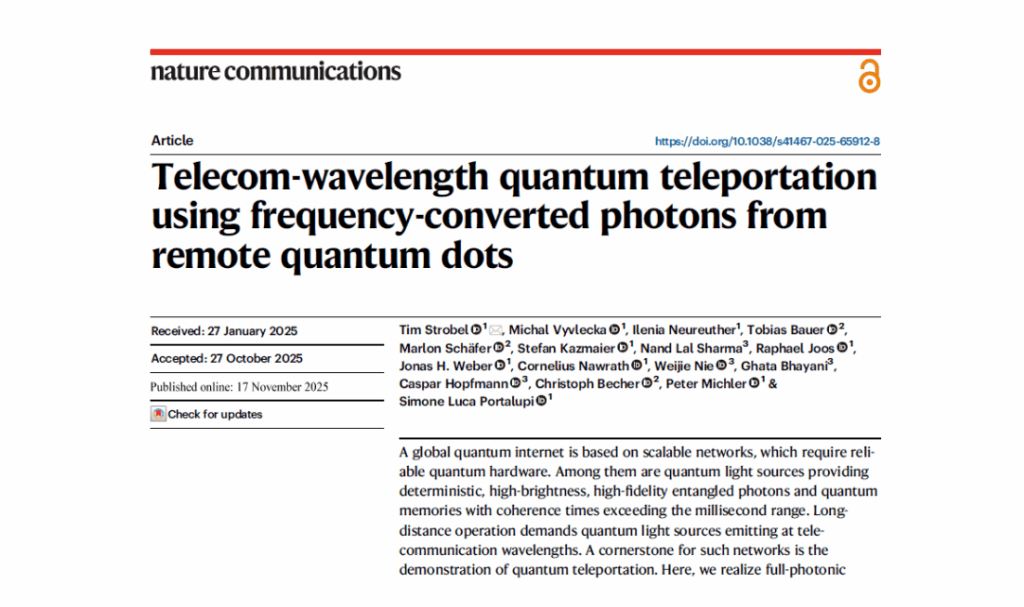
In their work, the research team demonstrates fully photonic Quantum Teleportation using semiconductor Quantum Dots that meet all necessary requirements. Two spatially separated GaAs Quantum Dots emitting in the near-infrared were used: one Quantum Dot served as a source of entangled photon pairs, and the other as a single-photon source. The single photon was prepared in conjugate polarization states and coupled, via a polarization-selective Bell-state measurement, with a photon (biexciton emission) from the entangled pair. In this way, the respective polarization state could be teleported onto the other photon (exciton emission) of the entangled photon pair. Two polarization-preserving Quantum Frequency Converters shifted the emission wavelength into the low-loss telecom band and also compensated for the existing frequency mismatch between the photon sources. The resulting post-selected teleportation fidelity was 0.721(33), well above the classical limit – a clear demonstration of successful teleportation between light from different sources. Click here for more information.
Further information on the publication is also available in the official press release from the Universität Stuttgart.
Source reference: https://www.nature.com/articles/s41467-025-65912-8