
Time-multiplexed Photonics enables High-Precision Quantum Gates for universal photonic Quantum Computers –
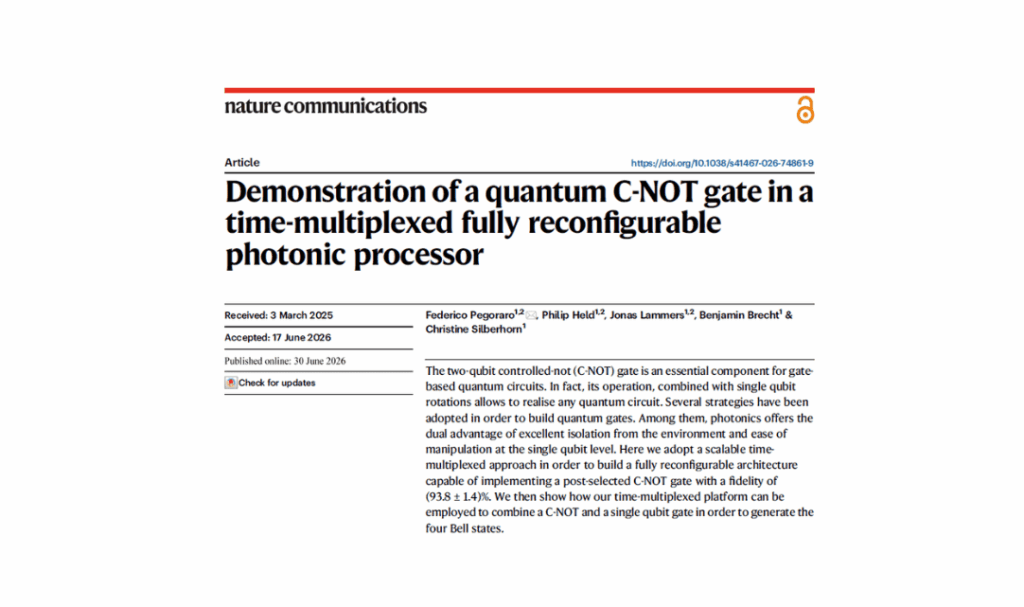
Quantum Computers promise to solve certain problems that are beyond the capabilities of classical computers. Photons are considered particularly promising carriers of Quantum Information because they are largely immune to environmental disturbances and can be precisely controlled at the level of individual qubits. A major challenge, however, is that photons interact only very weakly with one another by nature – an interaction that is essential for implementing quantum logic operations. Researchers from the QR.N consortium at the Paderborn site have now developed a novel time-multiplexed architecture that enables the realization of a high-precision photonic Quantum Gate Circuit. Among other components, the circuit implements a controlled-NOT (CNOT) gate, one of the fundamental building blocks of universal gate-based Quantum Computers. Combined with single-qubit operations, a CNOT gate enables the implementation of arbitrary Quantum Circuits, the generation of entanglement, and the execution of Quantum Algorithms. Compared with previous approaches based on complex and only limitedly scalable optical setups, the new architecture offers a promising route toward scalable photonic Quantum Computers. The results were published in Nature Communications at the end of June 2026.
In the paper, the researchers describe a scalable time-multiplexed architecture for photonic Quantum Computing. The platform is based on high-speed electro-optic modulators and can be programmed to implement an optical interferometer in the time domain. Instead of encoding Quantum Information spatially across different optical paths, the information is encoded in time. In this so-called time multiplexing approach, multiple qubits pass through the same optical module while being transmitted in different time bins. This significantly reduces the number of optical components required – a key advantage for scaling photonic Quantum Computers. Using this approach, the team realized a post-selected CNOT gate with a fidelity of approximately 94%. Furthermore, the researchers demonstrated how the time-multiplexed platform can combine a CNOT gate with a single-qubit gate to generate all four Bell states.
The results demonstrate that the time-multiplexed platform enables complex Quantum Operations to be implemented flexibly while opening new possibilities for larger reconfigurable Quantum Circuits. They also highlight both the high performance of the realized CNOT gate and the potential of the time-multiplexing approach as a platform for universal photonic Quantum Computing. Looking ahead, the team sees considerable potential in further advancing the hardware. Faster electro-optic switching could significantly increase data rates in the near future while further improving the overall efficiency of the system. The work therefore represents an important step toward scalable, universal photonic Quantum Computers.
Source reference: https://physik.uni-paderborn.de/en/news/news-item/skalierbare-photonische-quantencomputer-neuer-durchbruch-mit-zeitmultiplex-photonik