QTF Initiative presents Proposal for the Development of a nationwide fiber-optic Backbone for Quantum Communication and Time and Frequency Distribution –
In optical fiber networks, two key technologies have increasingly come into focus in recent years: Quantum Communication (Q) and the distribution of high-precision Time and Frequency (T&F) signals. Both technologies are considered important building blocks for future communication and infrastructure systems and open up new opportunities for Research and Development (R&D) in the field of physically secure data transmission as well as for the resilience of critical time infrastructures. However, realizing the full potential of these technologies requires more than the operation of isolated testbed fiber links. Instead, a connected, nationwide fiber-optic infrastructure is needed to make Quantum and T&F services accessible to a broad range of users. Currently, corresponding signals in Germany are only available to a limited number of institutions, making the development and operation of an appropriate research and development infrastructure at the national and European level a key prerequisite for further scaling these technologies.
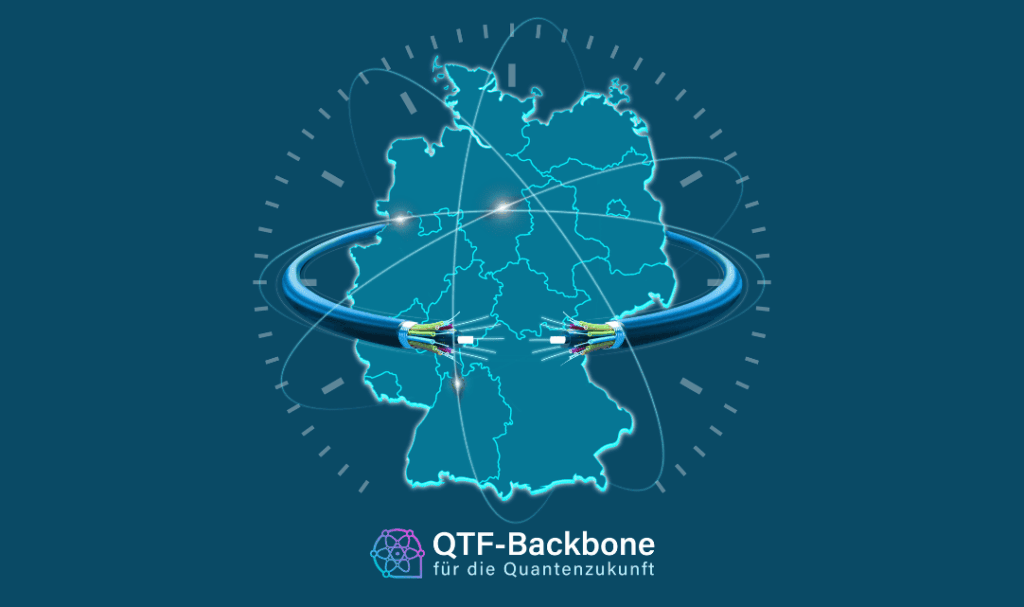
Against this background, the “Initiative for the Development of a Fiber-Optic Backbone for Quantum Communication and Time and Frequency Distribution in Germany” (QTF Initiative) was formed several years ago, with partners of the Schirmprojekt Quantenkommunikation Deutschland (SQuaD) also being involved. The initiative aims to establish an additional fiber-optic infrastructure for Quantum Technologies that is separate from the public internet. Over the coming decade, this infrastructure is intended to serve as a nationwide R&D infrastructure for applications in Quantum Communication and T&F distribution and to operate independently of the technical requirements of classical data communication. In late July 2026, a paper by the QTF Initiative was published in the European Physical Journal (EPJ), describing a large-scale fiber-optic network that connects research institutions across Germany and provides them with a dedicated infrastructure for experimental Quantum Links as well as time and frequency distribution – the so-called QTF Backbone.
The paper drafted by support from experts from 77 institutions throught Germany, has published a throrough proposal for a QTF Backbone to be developed and brought into operation in four phases over a period of ten years. The aim is to provide research institutions and industry with scalable and sustainable access to a nationwide QTF infrastructure and to enable new R&D opportunities beyond controlled laboratory environments. These include applications in the fields of Quantum Communication, Quantum Computing, Quantum Sensing, as well as other time- and frequency-critical applications in science and industry. In addition, the QTF Backbone is intended to support the development of a nationwide QTF ecosystem, facilitate the transfer of research results into practical applications, and serve as a national and European hub contributing to Germany’s integration into future pan-European fiber-optic networks.
Source references: https://www.ptb.de/cms/qtf-de-backbone.html; https://link.springer.com/article/10.1140/epjs/s11734-026–02451‑3