
New Approach paves the Way for more efficient and scalable Single-Photon Sources for Quantum Networks –
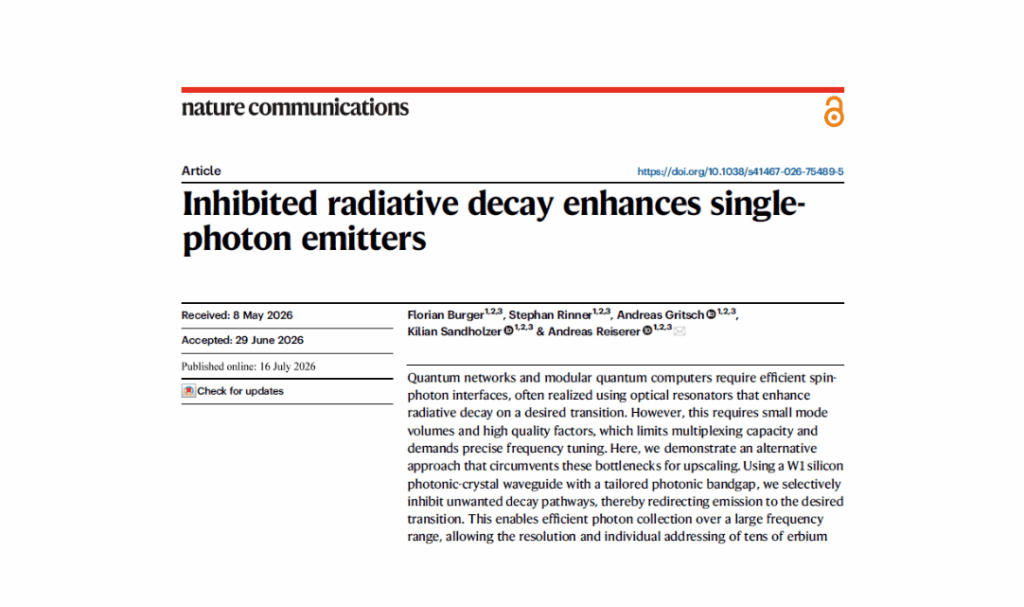
Quantum Networks and Quantum Computers require efficient single-photon sources to scale. Single photons can be generated in a controlled manner using solid-state emitters, but doing so is technically challenging. The emitters used for this purpose exhibit unwanted optical decay channels in addition to the desired emission, which can impair the efficiency and quality of the single photon sources. Against this background, researchers from the QR.N consortium in Munich, in collaboration with the Munich Center for Quantum Science and Technology (MCQST), have developed a new method for selectively suppressing unwanted emissions. The results were published in a paper in Nature Communications in mid-July 2026.
The photon source used in the experiment is based on erbium dopants in nanophotonic silicon waveguides. Erbium is particularly interesting for Quantum Networks because its optical transitions lie in the low-loss telecommunications band used by optical fibers. The researchers pursue a new approach to improving single-photon sources: Instead of making the emitters produce more light at a specific frequency, they modify the emitters’ optical environment so that emission at unwanted frequencies is suppressed. To achieve this, they use W1 silicon photonic-crystal waveguides with a tailored photonic bandgap. These nanostructures block certain pathways through which the emitter can radiate light. As a result, unwanted optical frequencies are selectively suppressed while the desired emission is preserved. This approach enables efficient photon collection over a broad frequency range and thus allows individual addressing of dozens of erbium emitters.
The experimental results confirm the effectiveness of the technology: Using the photonic-crystal waveguides, the researchers increased the proportion of desired photons in the emitted light from around 23% to approximately 72% – a value previously only achieved using significantly more complex resonator-based approaches. At the same time, photon generation is somewhat slower with the new approach than with conventional methods. This can be advantageous for Quantum Communication, as the properties of photons are more difficult to control when they are generated too quickly, according to Prof. Dr. Andreas Reiserer of the Technische Universität München (TUM). The approach is therefore better suited to many emitters than the resonators used previously. Since the photonic-crystal waveguides do not interfere with the emitter but merely modify its optical environment, they offer further advantages. First, multiple photon sources can be used simultaneously in a single device. This is only possible to a limited extent with resonators due to their small size. Second, the desired frequency can be selected more flexibly, as photonic-crystal waveguides do not need to be precisely tailored to each individual emitter like conventional resonators. In addition, the approach can be combined with Purcell enhancement and applied to other spin-qubit platforms. It therefore opens up new prospects for photonic Quantum Technologies and the development of future Quantum Networks.
Further information on the publication is also available in the official press release from the Technische Universität München.
Source references: https://www.tum.de/en/news-and-events/all-news/press-releases/details/tum-develops-single-photon-sources-for-quantum-communication; https://www.nature.com/articles/s41467-026-75489-5