
Key Building Block for Future Quantum Repeaters Demonstrated –
Quantum Communication Networks are expected to enable the exchange of Quantum States between distant locations in the future. However, building such networks involves numerous technological challenges. One key task is to generate entanglement efficiently and distribute it between nodes located far apart. This requires taking into account the fundamental constraints of Quantum Mechanics, in particular the no-cloning theorem, which prohibits the copying of unknown Quantum States. This is where Quantum Repeaters come into play: they are designed to enable the transmission of Quantum Information over long distances by distributing entanglement step by step across individual links and connecting these links. Entanglement swapping is an essential technique for achieving this.
Over the past decades, entanglement swapping has been demonstrated using various physical platforms. In these experiments, entanglement was generated locally either between an atomic spin and a photon or between two photons. Purely photonic entanglement swapping, in which Quantum Information is encoded in the degrees of freedom of photons, is of particular interest for technological applications. It enables the direct entanglement of flying qubits and thus the connection of spatially separated nodes. In addition, multiple entanglement-swapping processes can be chained together, which is important for building large-scale Quantum Networks. Efficient photon-photon entanglement swapping is also a key building block for photonic Quantum Computing. Previous demonstrations of purely photonic entanglement swapping between spatially separated systems relied on probabilistic light sources, which generate photon pairs with a certain probability. Increasing their excitation strength to raise the pair generation rate also increases the probability of generating unwanted multiple pairs. These can impair the quality of the resulting entanglement. This creates a fundamental trade-off between the generation rate and entanglement quality, limiting the scalability of such sources. Scalable Quantum Networks therefore require Quantum Emitters capable of generating photon pairs on demand without an increase in the generation rate necessarily resulting in a deterioration of entanglement quality. Quantum Dots offer promising prospects in this regard: as Quantum Emitters that can be excited on demand, they can generate entangled photon pairs on demand and are not subject to the same fundamental trade-off as probabilistic photon sources. This makes them particularly interesting for building larger Quantum Networks. Against this background, researchers from the QR.N consortium at the Würzburg, Paderborn, and Karlsruhe sites have succeeded in demonstrating photonic entanglement swapping using photon pairs generated by two spatially separated GaAs Quantum Dots. The results of the experiment were published in Science Advances in early November 2026.
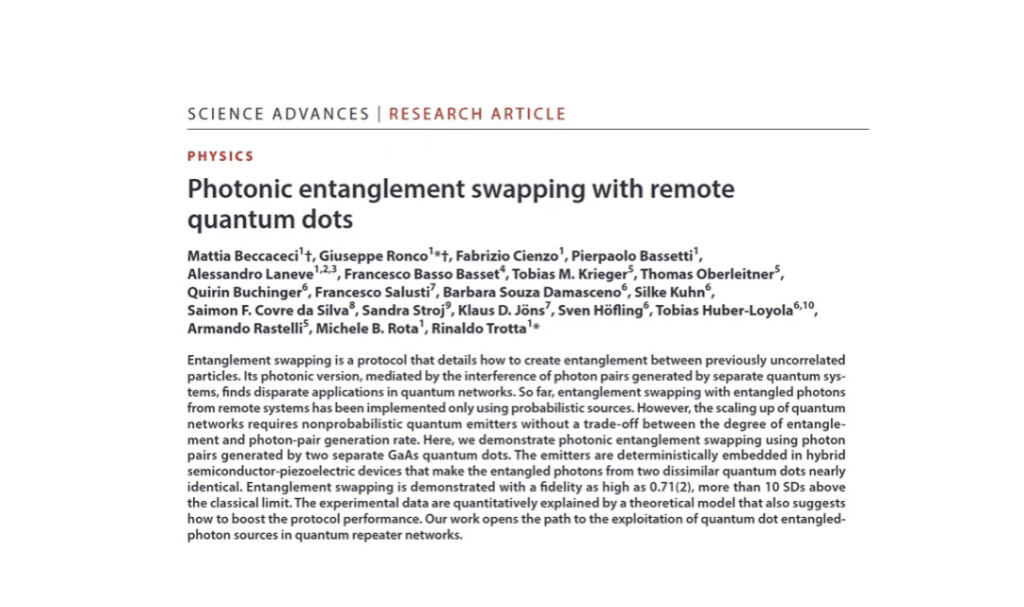
In their paper, the researchers describe an experiment demonstrating photonic entanglement swapping using entangled photon pairs from two spatially separated Semiconductor Quantum Dots. To this end, they generated two entangled photon pairs using two separate gallium arsenide (GaAs) Quantum Dots, each integrated into a circular Bragg resonator. The resonators enable efficient collection of the light emitted by the Quantum Dots. The Quantum Dots are integrated into hybrid semiconductor-piezoelectric devices. Their properties can be precisely tuned using three-axis piezoelectric actuators. This allows the photons emitted by the two sources to be matched so that they become nearly indistinguishable – an important prerequisite for their interference. Photons 1 and 2 form the first pair, while photons 3 and 4 form the second. Photons 2 and 3 are then brought to interfere and subjected to a joint Bell-state measurement. If a corresponding Bell state is detected, photons 1 and 4, which were not previously entangled, become entangled – even though they have never directly interacted with each other. The researchers achieved a fidelity of up to 0.71 ± 0.02, providing clear evidence of successful entanglement transfer.
Overall, the results pave the way for using on-demand sources of entangled photons based on Quantum Dots in Quantum Repeater Networks. They thus demonstrate an important building block for future Quantum Networks.
Source references: https://www.uni-paderborn.de/en/news-item/162599; https://www.science.org/doi/10.1126/sciadv.aeh7797?referrer=https%3A%2F%2Fidw-online.de%2F