National Geographic reports on how Quantum Teleportation works and its Benefits –
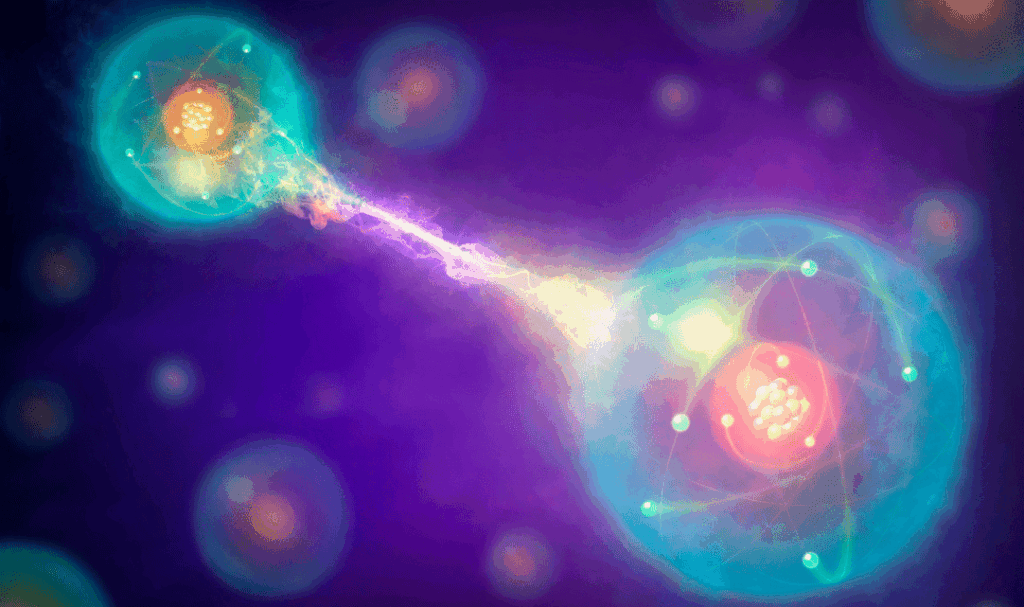
In everyday life, objects follow the familiar laws of classical physics. However, at the level of atoms and subatomic particles, entirely different – often counterintuitive – rules apply: those of Quantum Physics. In this realm, particles can exist in multiple states simultaneously until they are measured (superposition) and can be connected across large distances (entanglement). When two Quantum Systems are entangled, their states remain linked regardless of how far apart they are. This phenomenon forms the basis for new applications, such as secure communication.
The distribution of entanglement enables much more than that. It is, for example, a prerequisite for linking multiple Quantum Computers into larger networks. To achieve this, Quantum States must be transmitted between them – a challenging task, as these states are extremely fragile and can easily be disrupted during transmission. One possible solution is Quantum Teleportation: here, a Quantum State is transferred from a sender to a distant system without the particle itself traveling through space. Instead, the state is reconstructed at the receiver, without the communicating parties directly knowing it.
Since its theoretical description in 1993, Quantum Teleportation has evolved from an abstract concept into an experimentally verified reality – and is therefore more than just science fiction. Early experiments in the late 1990s demonstrated the transfer of Quantum States over short distances, while subsequent research extended this capability to increasingly larger scales. In the 2010s, researchers also showed that different types of Quantum Systems can be teleported, including states of superconducting circuits. All of these experiments are based on Quantum Entanglement.
Against this backdrop, an article published in National Geographic at the end of March 2026 explores the topic in detail. It features, among others, Dr. Simone Portalupi from the Universität Stuttgart, who is involved in the QR.N consortium. The article highlights the potential of Quantum Teleportation to usher in a new era of information processing and to expand our understanding of the subatomic world. While classical computers process information in binary form as 0 and 1, Quantum Computers use so-called qubits. These can exist in superposition states, allowing them to take on values between 0 and 1 – a key advantage over classical systems.
Commercial Quantum Computers already exist, but their capabilities remain limited. A crucial step toward more powerful systems is the ability to reliably transmit Quantum Information over longer distances and to interconnect multiple Quantum Computers. However, this is constrained by the so-called no-cloning theorem, which states that an unknown Quantum State cannot be copied without alteration. This is precisely where Quantum Teleportation comes in: it enables the transfer of Quantum States without directly copying them. In the long term, it could form the basis of a Quantum Internet and play a key role in future Quantum Computing Systems. Click here to read the article.
Source reference: https://www.nationalgeographic.com/science/article/quantum-teleportation-science-computing-physics