Experimental Progress for reliable Quantum Networks –
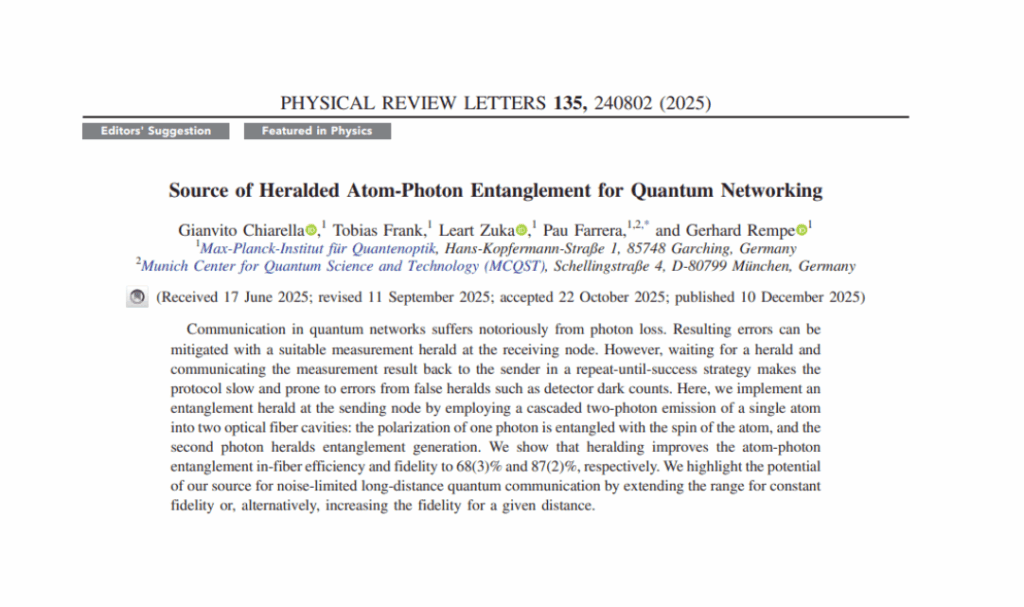
Over the past years, Quantum Networks have emerged as an important field of research. In addition to enhancing the security of critical infrastructures, they enable new applications such as the secure interconnection of Quantum Computers. However, the realization of such networks is technologically challenging. For example, Quantum Communication suffers from unavoidable photon losses during transmission. These losses often prevent the successful generation of entangled Quantum States between distant nodes. A promising approach to address this problem is the use of heralded protocols: through appropriate measurements at the sender or receiver node, it can be indicated whether the desired Quantum State has actually been generated. Failed transmission attempts can thus be reliably identified and discarded. Against this background, a new paper involving the QR.N consortium was published in mid-December 2025.
The article presents an experiment demonstrating the efficient, heralded generation of atom–photon entanglement. The aim is to reduce error rates in Quantum Networks without unnecessarily decreasing the effective communication rate. To this end, the researchers first generate the entanglement locally at the sending node. At the core of the experiment is a single atom that sequentially emits two photons via a cascaded emission process into two optical fiber resonators. The polarization of the first photon is entangled with the spin of the atom. Detection of the second photon reliably heralds the successful generation of the desired atom–photon entanglement. By conditioning on successful events, the efficiency of entanglement distribution through the fiber can be significantly enhanced.
While a conventional heralding signal is typically generated only at the receiving node, the method described in the paper instead shifts this heralding process to the sending node, offering several decisive advantages. First, the sender can immediately determine whether the generation of atom–photon entanglement was successful and, if necessary, initiate a new attempt without delay. This avoids unnecessary waiting times and communication overhead within the network. Second, the heralding signal does not need to be transmitted over long distances and is therefore not subject to loss-induced attenuation. As a result, it can be detected with a high signal-to-noise ratio. Moreover, the heralding signal provides precise timing information about the moment of entanglement generation. When this information is communicated to the receiver, the expected arrival time of the entangled photon can be accurately predicted. In this way, temporally uncorrelated events – particularly detector dark counts – can be effectively filtered out.
Overall, this approach represents a significant advance toward reliable, noise-limited long-distance communication protocols and has the potential to substantially increase the achievable communication range in future Quantum Networks.
Source reference: https://journals.aps.org/prl/abstract/10.1103/5zk9-3rpv#physics_summar