Partners
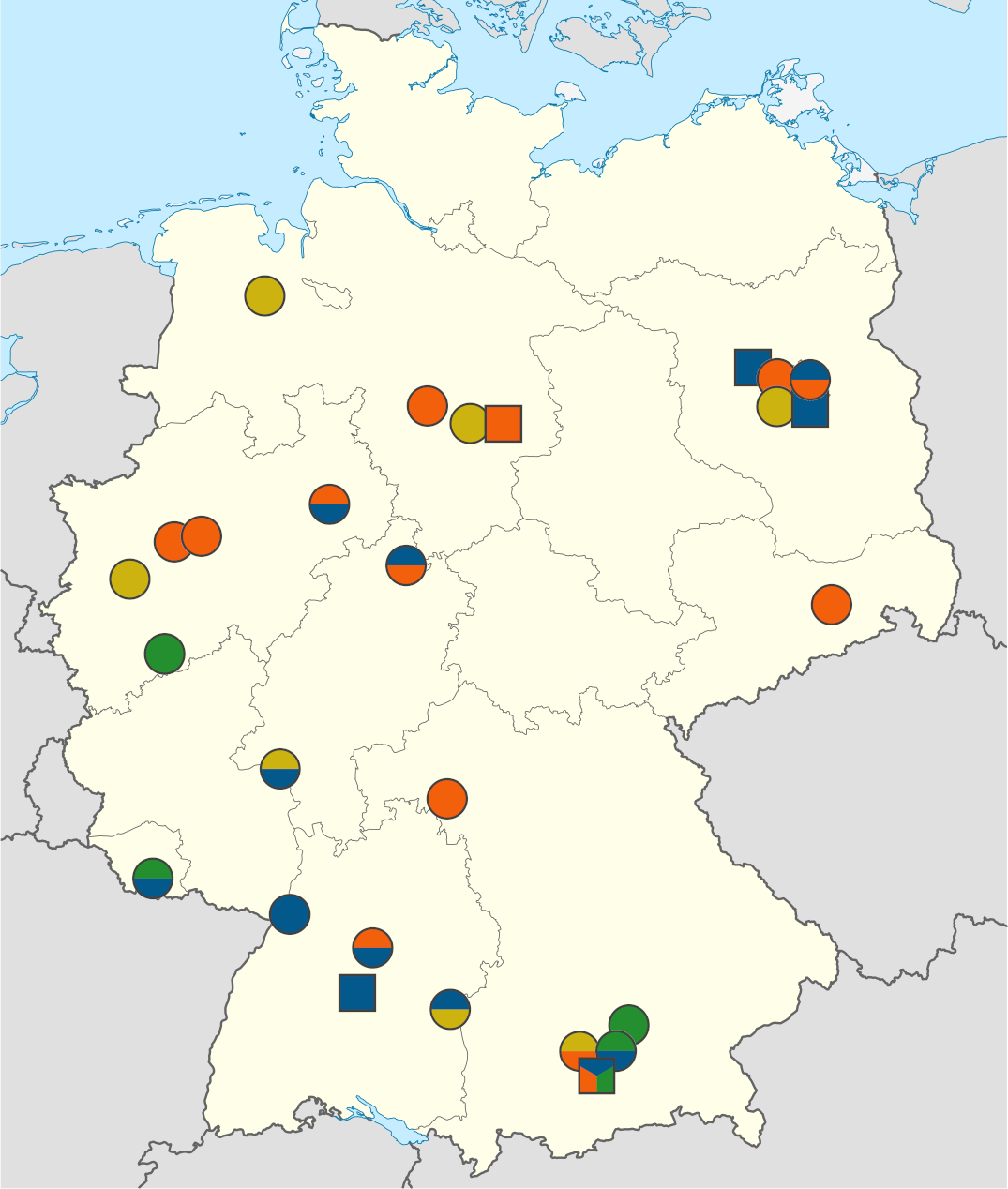
- QR-D (‘Color Centers in Diamond’)
- QR-H (‘Semiconductor Quantum Dots’)
- QR-A (‘Single Ions and Atoms’)
- QR-T (‘Theory’)
- Academic partners
- Non-academic partners
The QR.N consortium consists of 36 academic groups from 22 locations across Germany, 3 small and medium-sized enterprises (SMEs), Deutsche Telekom, the Fraunhofer-Institut für Nachrichtentechnik, Heinrich-Hertz-Institut (HHI), the Physikalisch-Technische Bundesanstalt (PTB), and nine advisory board members.
The 42 partners from universities, research institutions, and industry are assigned to four platforms.

Location: Universität des Saarlandes
Project Goals:
Operation of a Quantum Repeater Testbed with more than two nodes and hybrid hardware platforms (SnV centers and Ca⁺ ions); realization of a QR Segment, QR Cell, and QR Link; linking of elementary Quantum Processors; entanglement over an urban fiber connection as a resource for quantum-assisted classical communication

Location: Universität Bonn
Project Goals:
Fabrication and miniaturization of high-quality optical fiber resonators and their integration into atom traps as interfaces to material qubits

Location: Technische Universität München
Project Goals:
Development of chip-based Quantum Memories based on erbium-doped silicon that can store photons in the C-band at 1537.8 nm with a bandwidth of 1 GHz for at least 1 microsecond; extension of storage times into the millisecond range through dynamic decoupling and the use of nuclear spin states

Location: Max-Planck-Institut für Quantenoptik
Project Goals:
Multiplexing methods for the generation of atom-photon entanglement, generation and storage of photonic cluster states in a multi-qubit Quantum Node, and entanglement distribution over a 20 km urban telecom fiber link between Munich and Garching

Location: Johannes Gutenberg-Universität Mainz
Project Goals:
Simple QR protocols without Quantum Error Detection or Correction, further expansion of the existing toolbox for the analytical determination of exact and optimal QR Rates, extensions including QR Chains of increasing size and simple Quantum Network Toy Models with multiple parties, analysis and proposals of memory-based QRs of the 2nd generation for various platforms, real fiber channels, and networks

Location: Ludwig-Maximilians-Universität München
Project Goals:
Development and demonstration of a Quantum Segment between Munich and Garching via a 20 km deployed fiber link and the connection of different atomic Quantum Memories

Location: Universität Stuttgart
Project Goals:
Development of bright Quantum Light Sources based on neutral and charged Quantum Dots in the telecommunication C-band, realization of an experiment for entanglement distribution in the C-band with additional photon storage in a color center in diamond and with erbium atoms in silicon chips, implementation and testing of stand-alone, modular, and transportable Quantum Repeater Components on field fiber links, realization of highly efficient (> 90%) fiber coupling of single-photon sources and detectors at 900 nm and 1550 nm through targeted optimization of coupling elements and their designs for cryogenic operation, establishment of a Quantum Network with one client and one Quantum Server to demonstrate distributed Quantum Computing, in which individual photons or cluster states generated by Quantum Dot Sources are exchanged between client and server, construction of a three-node network for entanglement distribution and implementation of Quantum Network Protocols, and improvement of photon extraction, spin control, and extended memory registers
Location: Technische Universität Dortmund
Project Goals:
Time-resolved studies of spin lifetime and spin coherence for electrons and holes in ensembles of telecom Quantum Dot Molecules (1300–1600 nm), generation of a highly polarized nuclear spin state and investigation of its effect on the extension of electron spin coherence in near-infrared (NIR) Quantum Dots (900 nm)

Location: Universität Kassel
Project Goals:
Fabrication of Quantum Dots, Quantum Dot Molecules, and coupled Quantum Dots emitting in the telecom C-band; fabrication of high-quality InP-based resonators; production of bright Quantum Light Sources for polarization-entangled photons; optimization of PIN/Schottky diode structures; development of efficient, fiber-coupled QDs/QDMs; and fabrication of optimized photonic structures and resonators (PhC, waveguides, input/output couplers) to enhance the optical coupling of color centers

Location: Leibniz-Universität Hannover
Project Goals:
Development of single-photon sources and photon-pair sources and testing of these sources on a fiber link (Hanover – Braunschweig) together with a synchronization signal, with a focus on time, frequency, and polarization stabilization
Location: Technische Universität München
Project Goals:
Demonstration of a QR Cell based on photon pairs generated by two spins in a single Quantum Dot Molecule, and realization of a deterministic source of 2D repeater graph states

Location: Universität Stuttgart
Project Goals:
Development of bright Quantum Light Sources based on neutral and charged Quantum Dots in the telecommunication C-band, realization of an experiment for entanglement distribution in the C-band with additional photon storage in a color center in diamond and with erbium atoms in silicon chips, implementation and testing of stand-alone, modular, and transportable Quantum Repeater Components on field fiber links, realization of highly efficient (> 90%) fiber coupling of single-photon sources and detectors at 900 nm and 1550 nm through targeted optimization of coupling elements and their designs for cryogenic operation, establishment of a Quantum Network with one client and one Quantum Server to demonstrate distributed Quantum Computing, in which individual photons or cluster states generated by Quantum Dot Sources are exchanged between client and server, construction of a three-node network for entanglement distribution and implementation of Quantum Network Protocols, and improvement of photon extraction, spin control, and extended memory registers

Location: Julius-Maximilians-Universität Würzburg
Project Goals:
Demonstration of a Quantum Repeater Link by combining two QR Segments and a QR Cell between two end nodes and an intermediate station, and demonstration of a loss-tolerant connection of two nodes using cluster states

Location: Technische Universität Dresden
Project Goals:
Demonstration of an efficient Quantum Repeater Cell based on a hybrid Quantum System combining an entangled semiconductor Quantum Dot Photon-Pair Source and a diamond-based Quantum Memory, achieved through improvements in Quantum Frequency Converters and spectral bandwidth matching of both systems; execution of a demonstration of an integrated hybrid Quantum Repeater Cell suitable for transmitting entangled photons over long distances via telecommunication optical fibers

Location: Universität Paderborn
Project Goals:
Development of ultra-fast cryogenic electronics for controlling waveguide-integrated modulators for feed-forward operations, realization of PIN structures with embedded Quantum Dot Molecules for use as Quantum Memories and for generating cluster states, and development of novel frequency converters in thin-film lithium niobate

Location: Ruhr-Universität Bochum
Project Goals:
Fabrication of Quantum Dot Diode Samples with high photon extraction efficiency:
(i) Enabling technologies (see “Roadmap for Scalable Quantum Repeaters”): development of concepts and growth of charge-controlled, low-noise sources compatible with miniaturized resonator structures, development, fabrication, and analysis of doping concepts for:
a) Low-noise, cryogenically stable AlGaAs layers for ~780 nm GaAs quantum dot-based heterostructures with optimal tunnel coupling for charge-noise control (strong tunnel coupling) and reduced co-tunneling (weak tunnel coupling); growth and provision of high-efficiency 780 nm QD heterostructures
b) Quantum Dots at telecommunication wavelengths focusing on conductive, cryogenically and photostable, low-noise InAlGaAs pseudo- and metamorphic layers and optimal tunnel coupling, both compatible with miniaturizable photonic heterostructures
c) Ultra-low transition/contact resistances for ultra-fast diodes
(ii) Modularized Quantum Repeater Components for fiber links (sources, detectors, links): highly efficient, low-noise photon sources and high-coherence, high-fidelity spin-photon interfaces
(iii) Extended concepts: improvement of spin initialization and spin readout fidelity and speed; enhancement of spin-photon interface fidelity (Quantum Dots optimized to minimize photoionization and Auger processes), extension of spin dephasing times in semiconductor Quantum Dots

Location: Universität Stuttgart
Project Goals:
Development of bright Quantum Light Sources based on neutral and charged Quantum Dots in the telecommunication C-band, realization of an experiment for entanglement distribution in the C-band with additional photon storage in a color center in diamond and with erbium atoms in silicon chips, implementation and testing of stand-alone, modular, and transportable Quantum Repeater Components on field fiber links, realization of highly efficient (> 90%) fiber coupling of single-photon sources and detectors at 900 nm and 1550 nm through targeted optimization of coupling elements and their designs for cryogenic operation, establishment of a Quantum Network with one client and one Quantum Server to demonstrate distributed Quantum Computing, in which individual photons or cluster states generated by Quantum Dot Sources are exchanged between client and server, construction of a three-node network for entanglement distribution and implementation of Quantum Network Protocols, and improvement of photon extraction, spin control, and extended memory registers
Location: Technische Universität Berlin
Project Goals:
Integration of individual Quantum Dot Molecules into electrically controllable devices with ring resonators using in-situ electron-beam lithography, flip-chip bonding of the devices onto piezoelectric elements for spectral tuning, and optical and quantum-optical characterization of the fabricated Quantum Devices

Location: Universität Paderborn
Project Goals:
Development of ultra-fast cryogenic electronics for controlling waveguide-integrated modulators for feed-forward operations, realization of PIN structures with embedded Quantum Dot Molecules for use as Quantum Memories and for generating cluster states, and development of novel frequency converters in thin-film lithium niobate

Location: Universität des Saarlandes
Project Goals:
Operation of a QR Testbed with more than two nodes and hybrid hardware platforms (SnV centers and Ca⁺ ions); realization of a QR Segment, QR Cell, and QR Link; linking of elementary Quantum Processors; entanglement over an urban fiber link as a resource for quantum-assisted classical communication

Location: Humboldt-Universität zu Berlin
Project Goals:
Use of entanglement for multi-node QKD and distributed Quantum Computing over fiber links; wavelength-flexible conversion of photons from various defect centers; defects in resonant nanostructures, among others, for Quantum Gates and cluster state generation
Location: Karlsruher Institut für Technologie
Project Goals:
Optimized spin-photon interface for NV and SnV centers, integration into demonstrators and hybrid systems (Stuttgart); implementation of new schemes based on resonator reflection; miniaturized fiber-resonator systems; development of mobile cryostats with efficient microwave integration, vector magnets, and minimal vibration levels

Location: Universität Ulm
Project Goals:
UP1: Demonstration of an efficient light-matter interface based on individual GeV and PbV centers, including elements of Quantum Memories and integrated photonic crystal resonators; realization of entanglement between widely separated GeV centers; implementation of Quantum Interfaces between superconducting qubits and ensembles of color centers; UP2: Cavity-enhanced spin-photon interface for Group IV centers, particularly SiV centers in diamond with access to long-lived spins; improvement of coherence properties through appropriate alignment in the magnetic field; increase of single-mode photon collection efficiency to enable distribution over two nodes; integration of frequency conversion units into the telecom band; investigation of reflection-based cavity protocols
Location: Universität Ulm
Project Goals:
UP1: Demonstration of an efficient light-matter interface based on individual GeV and PbV centers, including elements of Quantum Memories and integrated photonic crystal resonators; realization of entanglement between widely separated GeV centers; implementation of Quantum Interfaces between superconducting qubits and ensembles of color centers; UP2: Cavity-enhanced spin-photon interface for Group IV centers, particularly SiV centers in diamond with access to long-lived spins; improvement of coherence properties through appropriate alignment in the magnetic field; increase of single-mode photon collection efficiency to enable distribution over two nodes; integration of frequency conversion units into the telecom band; investigation of reflection-based cavity protocols
Location: Universität Kassel
Project Goals:
Fabrication of Quantum Dots, Quantum Dot Molecules, and coupled Quantum Dots emitting in the telecom C-band; production of high-quality InP-based resonators; development of bright Quantum Light Sources for polarization-entangled photons; optimization of PIN/Schottky diode structures; development of efficient, fiber-coupled QDs/QDMs; and fabrication of optimized photonic structures and resonators (PhC, waveguides, input/output couplers) to enhance the optical coupling of color centers
Location: Humboldt-Universität zu Berlin
Project Goals:
Use of entanglement for multi-node QKD and distributed Quantum Computing over fiber links; wavelength-flexible conversion of photons from various defect centers; defects in resonant nanostructures, among others, for Quantum Gates and cluster state generation

Location: Johannes Gutenberg-Universität Mainz
Project Goals:
Testing and further development of modules (primarily SiV) at low temperatures; integration and investigation of SiV microstructures; upscaling and miniaturization of components; improvement of center quality through high-temperature annealing

Location: Humboldt-Universität zu Berlin
Project Goals:
Use of entanglement for multi-node QKD and distributed Quantum Computing over fiber links; wavelength-flexible conversion of photons from various defect centers; defects in resonant nanostructures, among others, for Quantum Gates and cluster state generation

Location: Universität Paderborn
Project Goals:
Development of ultra-fast cryogenic electronics for controlling waveguide-integrated modulators for feed-forward operations, realization of PIN structures with embedded Quantum Dot Molecules for use as Quantum Memories and for generating cluster states, and development of novel frequency converters in thin-film lithium niobate

Location: Karlsruher Institut für Technologie
Project Goals:
Optimized spin-photon interface for NV and SnV centers, integration into demonstrators and hybrid systems (Stuttgart); implementation of new schemes based on resonator reflection; miniaturized fiber-resonator systems; development of mobile cryostats with efficient microwave integration, vector magnets, and minimal vibration levels
Location: Universität Stuttgart
Project Goals:
Development of bright Quantum Light Sources based on neutral and charged Quantum Dots in the telecommunication C-band, realization of an experiment for entanglement distribution in the C-band with additional photon storage in a color center in diamond and with erbium atoms in silicon chips, implementation and testing of stand-alone, modular, and transportable Quantum Repeater Components on field fiber links, realization of highly efficient (> 90%) fiber coupling of single-photon sources and detectors at 900 nm and 1550 nm through targeted optimization of coupling elements and their designs for cryogenic operation, establishment of a Quantum Network with one client and one Quantum Server to demonstrate distributed Quantum Computing, in which individual photons or cluster states generated by Quantum Dot Sources are exchanged between client and server, construction of a three-node network for entanglement distribution and implementation of Quantum Network Protocols, and improvement of photon extraction, spin control, and extended memory registers
Location: Technische Universität München
Project Goals:
General protocols that are robust against manipulative behavior by participants, resilient to attacks/failures, and include zero-knowledge protocols

Location: Heinrich-Heine-Universität Düsseldorf
Project Goals:
Network structures for Quantum Repeaters: Quantum Routers for multipartite entanglement distribution, strategies for securing classical information in superdense coding, Quantum Routers with multiplexing, and application of Quantum Error Correction
Location: Technische Universität Braunschweig
Project Goals:
Consideration of Quantum Repeaters in Quantum Communication Networks, entanglement as a resource, simple Quantum Protocols, and superdense coding protocols for potential experimental implementation with Quantum Memories (“proof-of-concept”)

Location: Freie Universität Berlin
Project Goals:
Secure multipartite Quantum Networks “beyond point-to-point QKD,” optimization of multipartite protocols, development of protocols for entanglement distribution, and simulation platform for Quantum Repeaters

Location: Carl von Ossietzky Universität Oldenburg
Project Goals:
Modeling of gate sequences in repeater protocols in close collaboration with the experimental partners in QR-H. The goal is to determine optimal parameters for growth/prototype realization to maximize transmission rates, indistinguishability, and fidelities in entanglement generation, as well as to enable comparison of different protocols within the QR-T theory consortium.

Location: HighFinesse GmbH
Project Goals:
Development of laser frequency controllers for multiple spatially separated Quantum Emitters; research on laser frequency measurement techniques for semiconductor Quantum Dots (wavelength range 900–950 nm) and development of laser frequency controllers; conducting similar R&D activities for telecommunication wavelengths (1530–1560 nm) and evaluation of frequency stabilization techniques
Associated Platform: QR-D
Location: Fraunhofer-Institut für Nachrichtentechnik, Heinrich-Hertz-Institut (HHI)
Project Goals:
Development of modules for entanglement transfer and their integration into optical transmission systems and fiber test links; demonstration of entanglement distribution in a 3+X Quantum Network; demonstration of entanglement-based Quantum Key Distribution using multiplexed Quantum Channels
Associated Platform: QR-D

Location: Deutsche Telekom AG / Tlabs
Project Goals:
Provision of the DTAG TestNet for the integration and demonstration of technologies developed by the project partners: network-side integration of Quantum Repeater Components in the DTAG R&D TestNet (frequency converters, Quantum Memories, photon sources, BSM apparatus), continuation, expansion, and operation of the DTAG TestNet (SASER) to integrate research laboratories and experiments with the goal of enabling and demonstrating the operation of advanced Quantum Technologies in real network infrastructures; investigation of co- and counter-propagation of signals in Quantum and Protocol Channels (in frequency-multiplexed systems); application of Quantum Memories in Quantum Network Links: generation and storage of entangled Quantum States at different network nodes to transmit and process classical or Quantum Information via dense coding or the teleportation protocol
Associated Platform: QR-D

Location: Physikalisch-Technische Bundesanstalt (PTB)
Project Goals:
Establishment of a Quantum Repeater Testbed between PTB and the University of Hanover to transmit quantum-cryptographically encrypted information, based on a QKD testbed (BB84 and BBM92 protocols); modification of the PTB–Hanover fiber link to meet the requirements of a Quantum Repeater Connection while maintaining time and frequency transfer properties; implementation of suitable frequency splitters to enable simultaneous transmission of entangled photons and optical reference frequencies without mutual interference; metrological characterization of the components
Associated Platform: QR-H
Location: Physikalisch-Technische Bundesanstalt (PTB)
Project Goals:
Establishment of a Quantum Repeater Testbed between PTB and the University of Hanover to transmit quantum-cryptographically encrypted information, based on a QKD testbed (BB84 and BBM92 protocols); modification of the PTB–Hanover fiber link to meet the requirements of a Quantum Repeater Connection while maintaining time and frequency transfer properties; implementation of suitable frequency splitters to enable simultaneous transmission of entangled photons and optical reference frequencies without mutual interference; metrological characterization of the components
Associated Platform: QR-H

Location: Qlibri GmbH
Project Goals:
Development and provision of robust, scalable low-temperature fiber-resonator platforms, including control software and hardware; design for integration of magnetic field and microwave components by KIT and adaptation to cryostats as a module for use outside laboratory environments (repeater demonstrator, miniaturization)
Associated Platform: QR-D

Location: Qubig GmbH
Project Goals:
Funding for Quantum Research & Technology through the provision of novel electro- and acousto-optical devices (modulators) for manipulating Quantum States using sub-nanosecond pulses, which are sliced from CW lasers in the visible and UV spectral ranges; development and demonstration of a compact setup including high-voltage electronics and customized electro-optical modulators for generating sub-ns light pulses with high energy and repetition rates up to the MHz range; achieving extinction of up to 60 dB using a combination of electro-optical modulators and deflectors to enable precise control of trapped ions/atoms; generation and manipulation of Rydberg states, Raman excitations, as well as preparation and readout of Quantum Memories
Associated Platform: QR-A
Location: Airbus Quantum Technology Central

Location: Quantum Optics Jena GmbH

Location: Technische Universität München