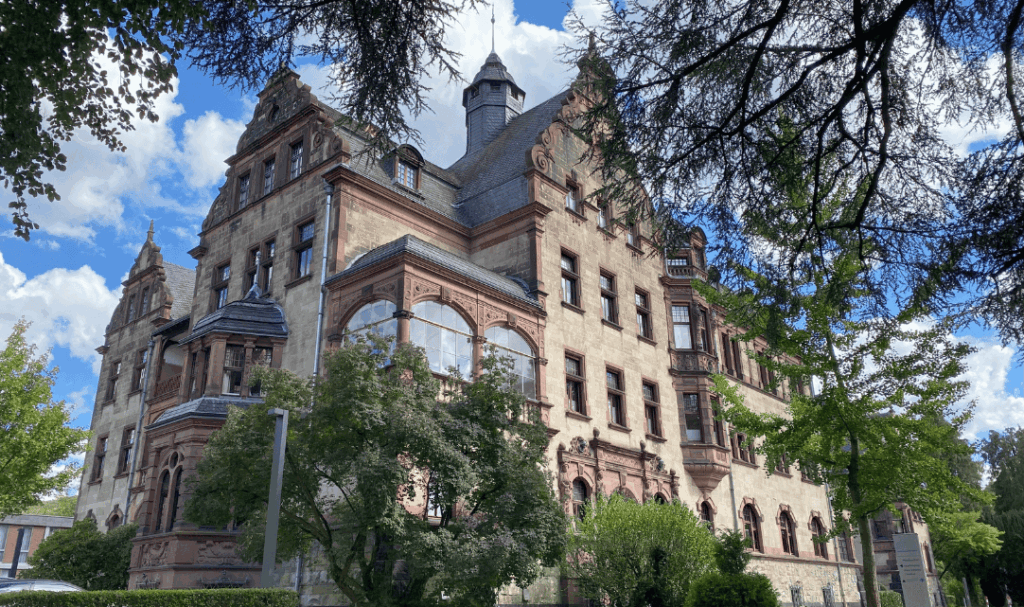
About 90 participants gathered in early September 2025 at the Physikzentrum Bad Honnef (PBH) for the first internal workshop of the joint project „Quantenrepeater.Net (QR.N)“. In his opening remarks, project speaker Prof. Dr. Christoph Becher not only presented the goals of QR.N but also referred to the recently adopted Hightech Agenda Deutschland. This agenda identifies the technological demonstration of Quantum Repeaters as a key objective in the field of Quantum Technologies: „It’s a challenge, and we accept this challenge.“
The two workshop days were structured into four thematic blocks. The first focused on networking Quantum Computers. Presentations by Pieter-Jan Stas (Harvard University), Stephan Welte (University of Stuttgart), and Peter van Look (Johannes Gutenberg University Mainz) provided insights into initial demonstrations, requirements, and challenges. After the coffee break, entanglement-assisted classical communication took center stage. In a joint talk, Jonas Hawellek (Technische Universität Braunschweig), Gregor Pieplow (Humboldt-Universität zu Berlin), Tara Liebisch (Physikalisch-Technische Bundesanstalt, PTB), and Ghislaine Coulter-de Wit (Heinrich Heine University Düsseldorf) explored the topic from both theoretical and experimental perspectives. The first day concluded with a poster session that impressively showcased the diversity of activities within the QR.N project.
The second day began with a thematic block on Quantum Repeater Links and demonstrators. Jörg Wrachtrup (University of Stuttgart), Sven Höfling (Julius Maximilian University of Würzburg), Nathan Walk (Freie Universität Berlin), and Jürgen Eschner (Saarland University) provided in-depth insights into the current technological state and future challenges of Quantum Repeater Technology. The final block focused on enabling technologies. David Appel (Quantum Design Europe), Florian Otto, Sebastian Schaile (attocube systems), Wolfgang Wernsdorfer (Karlsruhe Institute of Technology, KIT), and Sven Höfling (Julius Maximilian University of Würzburg) discussed key requirements for magnetocryostats and lasers that are essential for building large-scale Quantum Repeater Networks. Finally, Janis Nötzel (Technical University of Munich) addressed the question of how distributed academic research teams can achieve joint results in field trials without losing their scientific autonomy.
Overall, the QR.N workshop was a thoroughly successful event – marked by insightful presentations and lively discussions from which participants will certainly benefit for a long time to come.
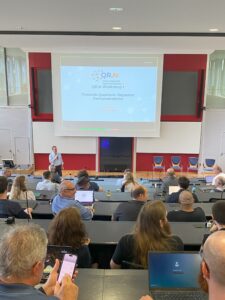

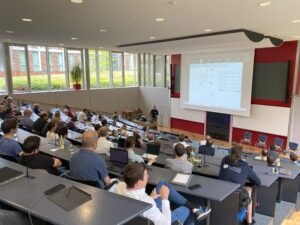
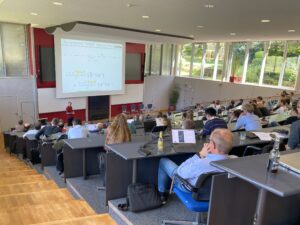


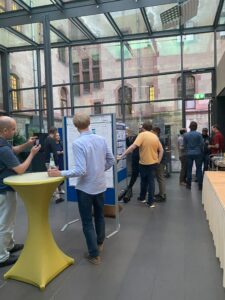
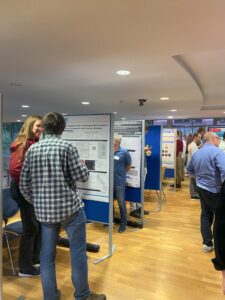
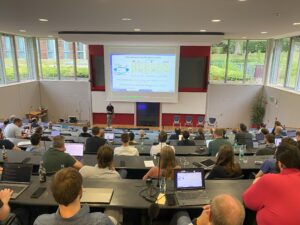
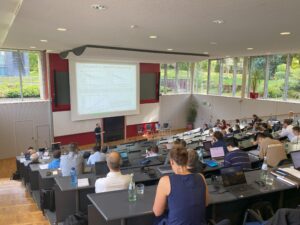

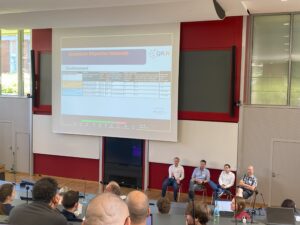
Photos: Impressions of the QR.N workshop.