
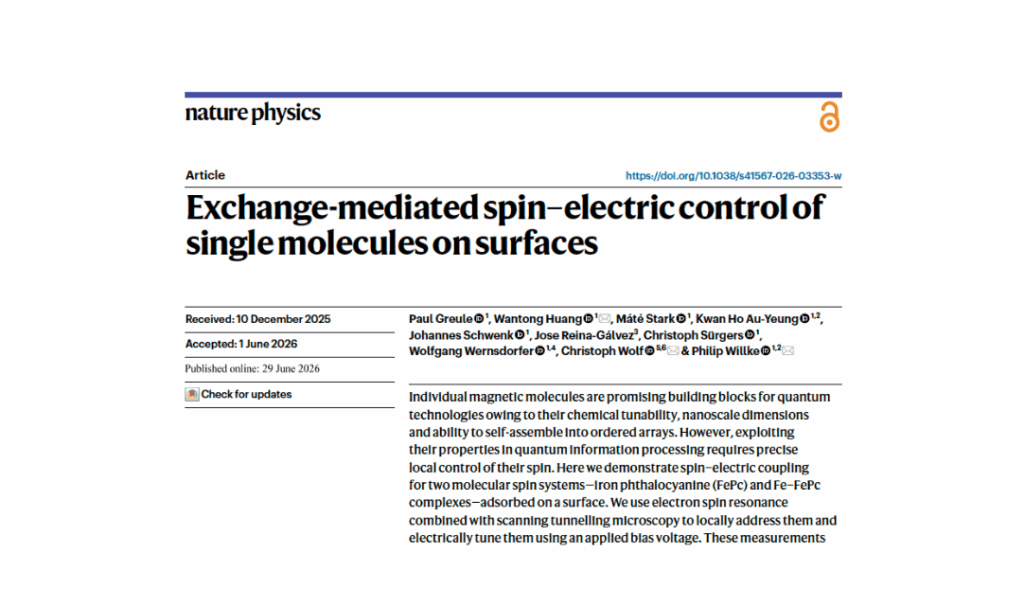
New Approach opens up new Possibilities for the precise electrical Control of electron Spins –
Quantum Technologies are considered a key enabling technology for more powerful computers, secure communication, and highly sensitive sensors. Individual magnetic molecules are promising building blocks for applications in spintronics, Quantum Computing, and Quantum Sensing. Owing to their nanoscale dimensions, they exhibit pronounced Quantum Properties and can be tailored to specific applications through modern chemical synthesis. For their use in Quantum Information Processing, precise control of their quantum mechanical spin is essential. Until now, this has primarily been achieved using magnetic fields, which are difficult to confine to individual molecules and can be switched only at limited speeds. Researchers from the QR.N consortium at the Karlsruhe site have now developed a new approach that enables the spin of individual magnetic molecules on a surface to be controlled using an electric voltage. Their results were published in Nature Physics at the end of June 2026.
In their paper, the researchers present a new method for the targeted control of molecular spins. In contrast to magnetic fields, an electrical voltage enables fast and highly localized spin control through efficient spin-electric coupling. Using a combination of electron spin resonance and scanning tunneling microscopy, the team investigated iron phthalocyanine (FePc) molecules and Fe-FePc complexes adsorbed on a surface. These systems are particularly well suited for such studies due to their stability on the surface. Using the new approach, the researchers were able to individually address single molecules and precisely modify their magnetic properties – in particular their spin – by applying an electrical bias voltage.
Electrical methods for spin control could become an attractive alternative to more complex magnetic control techniques in the future. In the long term, this approach opens up new perspectives for the development of scalable Quantum Computers as well as applications in Quantum Sensing and spintronics. At the same time, the work demonstrates that molecular Quantum Systems can be controlled with high precision by electrical means – an important step toward more efficient Quantum Operations and future molecular Quantum Technologies.
Source reference: https://www.kit.edu/kit/pi_2026_064_molekuelspins-fuer-quantentechnologien-gezielt-elektrisch-kontrollieren.php