
Review highlights Advances in epitaxial Growth, Telecom-Band Quantum Dots, and Nanophotonic Integration –
Quantum Light Sources are a central building block of photonic Quantum Technologies that enable secure communication, Quantum Networks, quantum-enhanced sensing, distributed Quantum Computing, and Quantum Metrology. An ideal source should emit single photons on demand with high efficiency, high indistinguishability, and minimal multiphoton contributions. Semiconductor Quantum Dots are among the most promising classes of deterministic single-photon sources, as they combine atom-like optical properties with scalable fabrication and integrability. They can emit single photons or entangled photons and can be engineered to cover a wide spectral range – from the visible spectrum to the telecommunications bands. As a result, these nanostructures offer several key advantages, including extremely low multi-photon emission probabilities, high photon fluxes, and the potential for large-scale production using well-established semiconductor fabrication technologies.
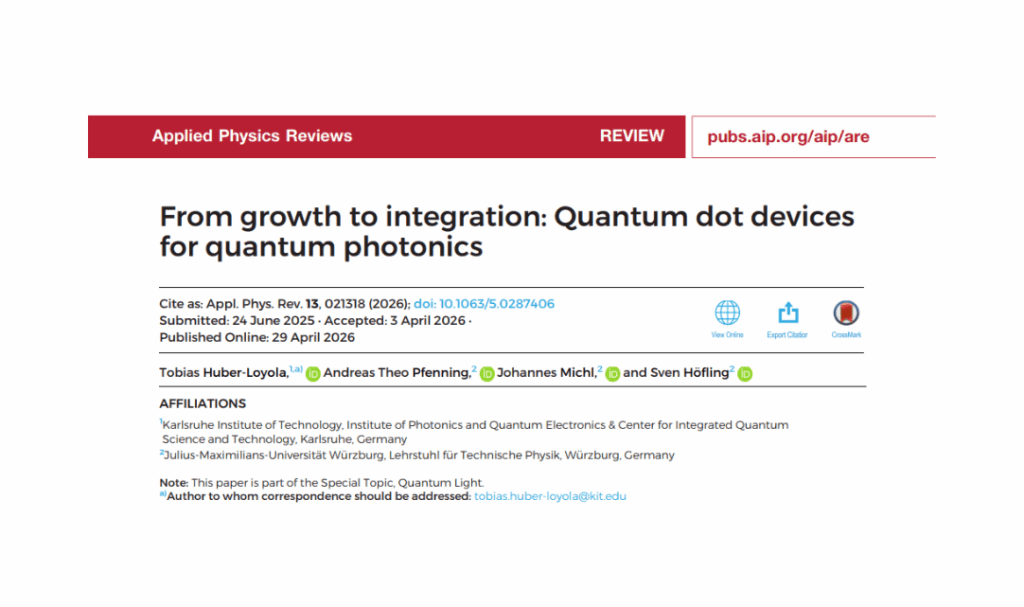
The operation of Semiconductor Quantum Dots has been thoroughly demonstrated in the visible and near-infrared spectral regions. Current research increasingly focuses on adapting these devices to emit within the telecommunication wavelength bands. Compatibility with these frequency ranges is considered a major milestone toward the realization of fiber-integrated Quantum Networks. Against this background, researchers from the QR.N consortium at the Karlsruhe and Würzburg sites have published an article in Applied Physics Reviews.
The review provides an overview of various methods for the growth of Quantum Dots, as well as strategies implemented at the device level to improve their optical performance across a range of emission wavelengths. In particular, the team examines major advances in epitaxial growth techniques on indium phosphide (InP) substrates and innovations in mechanical strain tuning using piezoelectric elements. In addition, approaches for photonic integration using micropillar cavities and circular Bragg grating structures are presented. Another focus lies on recent progress in enhancing photon indistinguishability within the telecommunications C-band. Here, the researchers discuss advanced excitation schemes and approaches from cavity quantum electrodynamics, including the deterministic cavity positioning.
The results of the study underscore the strong potential of quantum dot-based devices as foundational components for scalable, high-performance Quantum Photonic Systems and at the same time demonstrate promising prospects for their use in future Quantum Communication and Quantum Network Applications.
Source reference: https://pubs.aip.org/aip/apr/article/13/2/021318/3388415/From-growth-to-integration-Quantum-dot-devices-for