
Experiment enables Exploration of complex Quantum Networks –
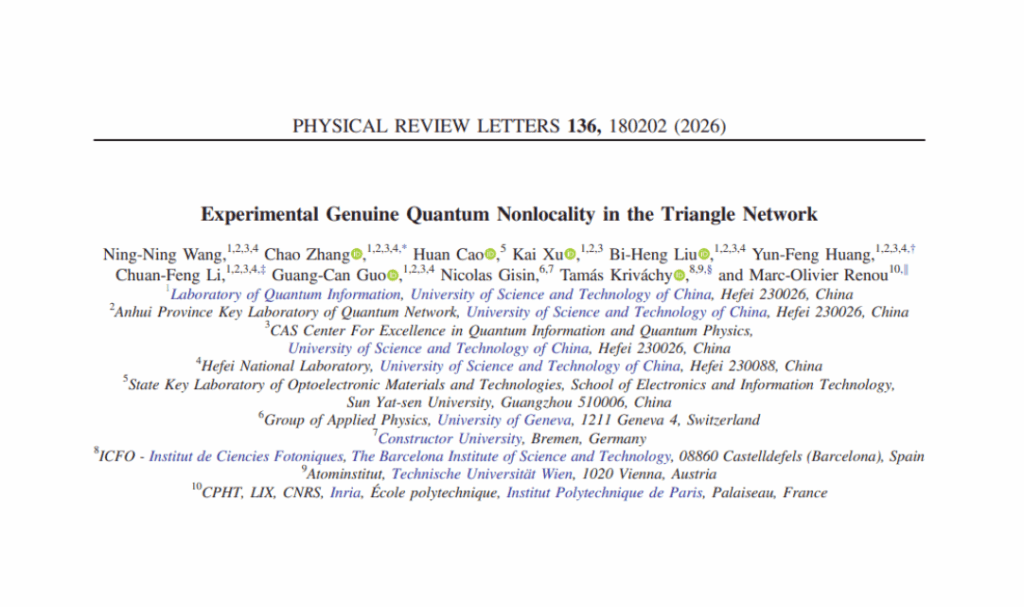
Bell’s theorem, for which Alain Aspect, John F. Clauser, and Anton Zeilinger received the 2022 Nobel Prize in Physics, states that entangled particles remain connected even when separated by large distances. This phenomenon, known as Quantum Nonlocality, has for decades been regarded as a key demonstration that nature follows the probabilistic rules of Quantum Mechanics, which go beyond classical physics. An international research team from China, Germany, Switzerland, Austria, Spain, and France has now extended this principle: using a so-called “elegant triangle,” the researchers demonstrated new forms of Quantum Nonlocality in networks with multiple nodes. The results were published in Physical Review Letters in early May 2026.
In the paper, the researchers describe how they applied Bell’s theorem to complex networks. “Dies ist etwas völlig Neues, das erst dann entsteht, wenn mehrere unabhängige Quantenquellen durch verschränkte Messungen interagieren,” explains Prof. Dr. Nicolas Gisin from Constructor University in Bremen, who was involved in the experiment. While conventional Bell tests rely on a single source of entangled particles, the research team investigated nonlocality in a network consisting of multiple independent sources and interconnected nodes for the first time. To achieve this, the researchers used a so-called “triangle network,” in which three parties were connected through three separate sources of entangled particles. Unlike conventional Bell experiments, the measurements were fixed rather than randomly selected. Each party analyzed particles originating from two independent sources, resulting in a significantly more complex network of Quantum Correlations.
The results show that even in a network with multiple independent sources and fixed measurements, Quantum Correlations can arise that cannot be explained by classical physics. The research team was able to demonstrate for the first time an independent form of network nonlocality known as “Genuine Quantum Network Nonlocality,” which emerges directly from the structure of the Quantum Network and cannot be reduced to conventional two-particle Bell scenarios. Using mathematical analyses and machine learning methods, the researchers showed that the observed correlations cannot be reproduced by classical models. The findings suggest that Quantum Nonlocality is not limited to controlled laboratory conditions, but also extends to complex network structures that could underpin future Quantum Technologies. The experiment therefore provides important insights for the development of large-scale Quantum Networks, for example for secure Quantum ommunication or the interconnection of Quantum Computers over long distances. At the same time, the results pave the way for further experiments involving even larger and more complex Quantum Networks.
Source reference: https://nachrichten.idw-online.de/2026/05/11/auf-dem-weg-zum-quanteninternet-wegweisendes-experiment-erlaubt-erforschung-komplexer-quantennetzwerke