
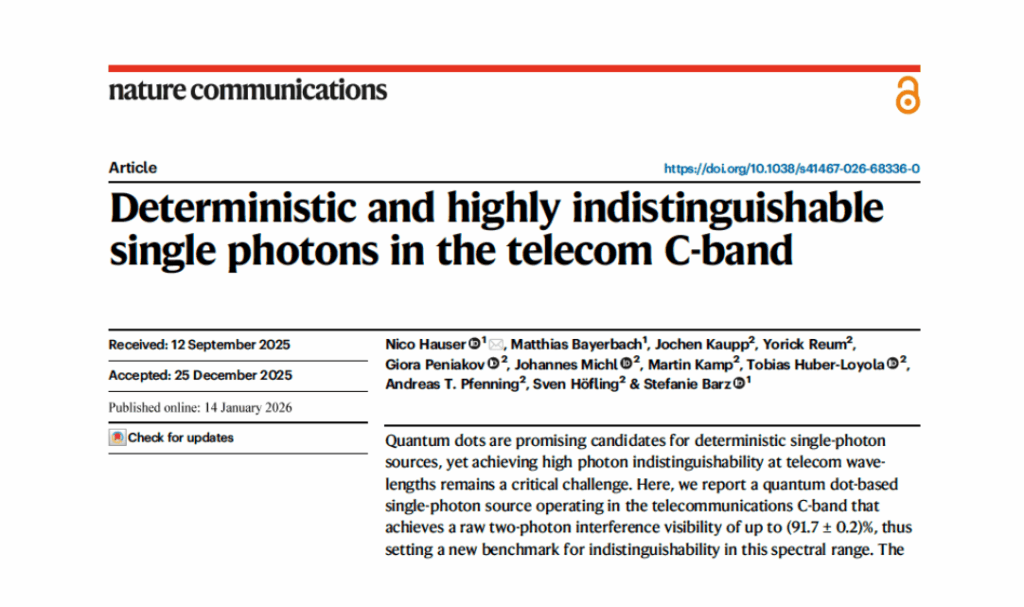
Source generates Photons on Demand in the Telecom C-band with Record Quality –
In Quantum Technologies, high-quality interference between photons is essential. Photons can only interfere perfectly if all their properties match – in other words, if they are practically identical. At the same time, such photons must be compatible with existing fiber-optic infrastructure. To achieve this, quantum-dot-based photon sources should operate in the telecommunications C-band at a wavelength of around 1550 nm, where optical losses in fibers are minimal. This combination posed a major challenge for a long time: while single-photon sources at shorter wavelengths between 780 and 960 nm achieve near-ideal properties, transferring this quality to the telecom C-band remained difficult for many years. To overcome this obstacle, researchers from the QR.N network at the Stuttgart and Würzburg sites developed a novel light source that generates individual photons in the telecom C-band on demand and with record quality. The results have now been published in a paper.
The developed source is a deterministic single-photon source: unlike probabilistic approaches, where it is unpredictable when a single photon will actually be available, it reliably produces exactly one photon with each targeted excitation. This property is crucial for many applications in Quantum Communication and Quantum Computing. Technically, the source is based on indium arsenide Quantum Dots embedded within indium aluminium gallium arsenide and integrated into a circular Bragg grating resonator, which enhances photon emission. While Quantum-Dot Devices for the telecom C-band already exist, they previously achieved two-photon interference visibilities of only around 72% – a measure of photon indistinguishability – which is insufficient for demanding Quantum Applications. The novel photon source overcomes this limitation by employing specifically optimized excitation schemes. The researchers systematically compared different excitation methods and found that a phonon-mediated excitation – that is, via elementary vibrations in the crystal lattice – yields the best results. Using this method, the team achieved a two-photon interference visibility of nearly 92% – the highest value ever obtained for a deterministic single-photon source in the telecom C-band.
The ability to generate photons with the quality of probabilistic sources while also making them available on demand marks an important step toward scalable Quantum Communication and photonic Quantum Computing. In the future, such sources will enable applications requiring large numbers of synchronized photons, as well as the networking of multiple photonic processors for distributed Quantum Computing, which is being pursued within the QR.N network.
Source reference: https://www.uni-stuttgart.de/en/university/news/all/Record-breaking-photons-at-telecom-wavelengths–on-demand/