
Demonstration of a coherent Spin-Photon System with promising Properties for Quantum Network Nodes –
Group-IV color centers are defects in the lattice structure of diamond that exhibit stable optical and addressable electron-spin transitions. Control over the surrounding nuclear spins is particularly important, as their long coherence times make them robust Quantum Memories for Quantum Information Processing. In combination with optically addressable spin defects in diamond, these systems enable promising spin-photon interfaces – key building blocks for future Quantum Networks.
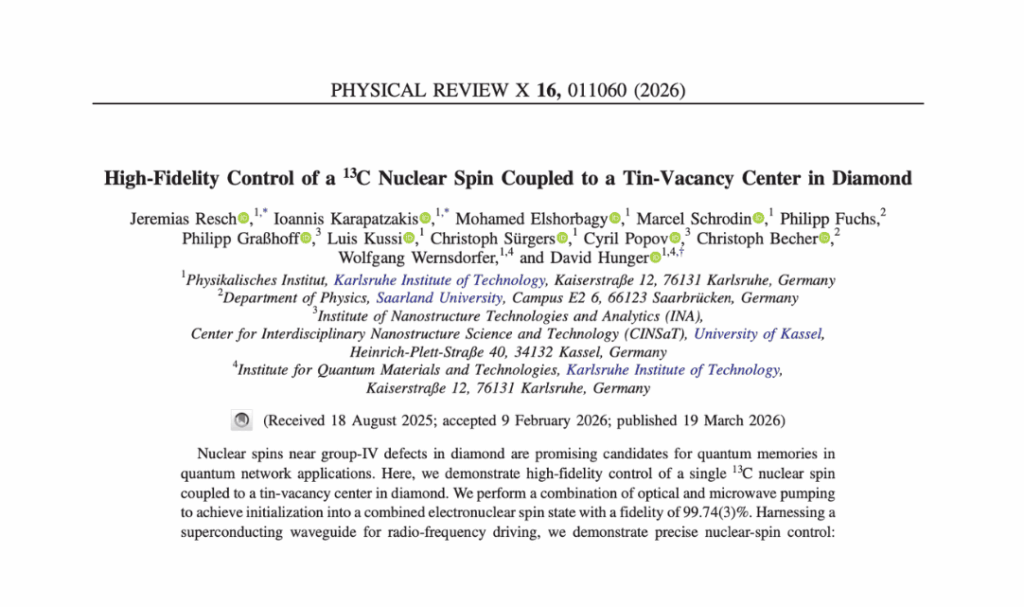
Despite significant progress in extending electron spin coherence times, existing systems have so far been insufficient for scalable Quantum Networks. Against this backdrop, researchers from the QR.N consortium at the Karlsruhe, Kassel, and Saarbrücken sites published a new paper in Physical Review X in mid-March, reporting on the high-fidelity control of a single strongly coupled ¹³C nuclear spin in the vicinity of a negatively charged tin-vacancy center (SnV⁻). Using optically detected magnetic resonance, the hyperfine interaction was characterized, and the nuclear spin was initialized into a well-defined state with an accuracy exceeding 99% through a combination of optical and microwave pumping.
In the article, the researchers further demonstrate coherent control of a single ¹³C nuclear spin coupled to a tin-vacancy center by employing a superconducting coplanar waveguide for efficient high-frequency control, thereby minimizing heat introduced into the system. By combining optical and microwave pumping, they achieved initialization into a combined electronuclear spin state with a fidelity of 99.74%. In addition, the experiments demonstrate precise nuclear-spin control, with the coherence time extended to up to 1.35 seconds using dynamical decoupling. Furthermore, a single-qubit gate fidelity exceeding 99.9% was verified through randomized benchmarking. These results demonstrate a coherent spin-photon system with promising properties for use as nodes in Quantum Networks and highlight the potential of tin-vacancy centers as coherent spin-photon interfaces for future applications in Quantum Communication.
Source reference: https://journals.aps.org/prx/abstract/10.1103/bmc6-qvwq