
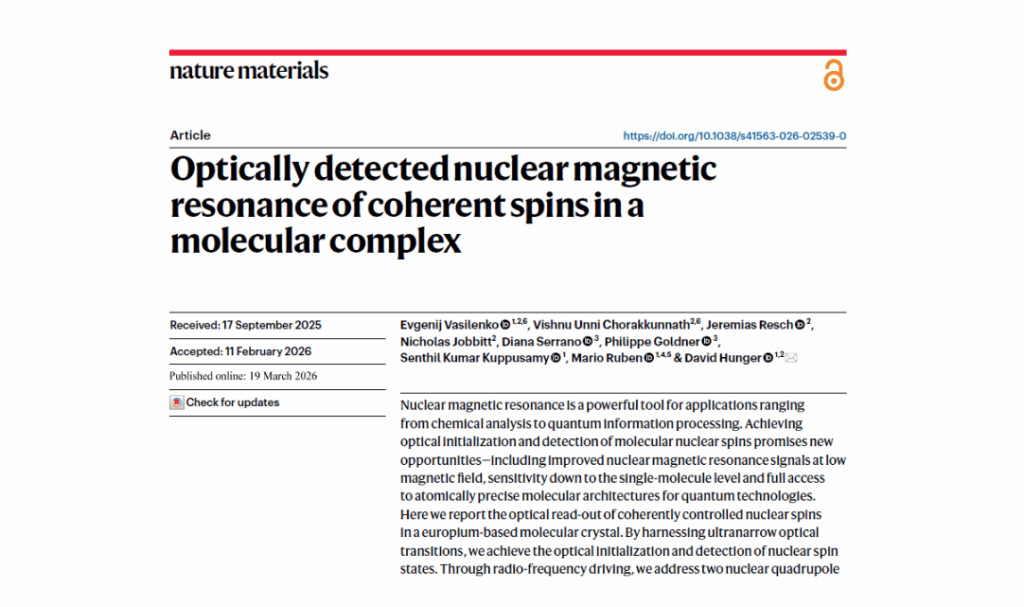
Research Team demonstrates full Optical Control of Nuclear Spins in a Molecular System –
Nuclear Magnetic Resonance (NMR) is an established method for investigating materials and molecules, ranging from chemical analysis to Quantum Information Processing. Due to their weak interaction with the environment, nuclear spins are considered particularly stable carriers of Quantum Information. Researchers from the QR.N consortium at the Karlsruhe site have now, for the first time, succeeded in optically initializing, controlling, and reading out nuclear spins in a molecular material. The results, recently published in Nature Materials, demonstrate that molecular nuclear spins could serve as promising building blocks for future Quantum Technologies.
In their study, the KIT team investigated a molecular crystal containing europium ions, which was synthesized and comprehensively characterized at the Institut für QuantenMaterialien und Technologien and at the Institut für Nanotechnologie at KIT. These ions exhibit exceptionally narrow optical transitions, enabling direct access to nuclear spin states. Using laser light, the researchers were able to initialize the nuclear spins into well-defined states and subsequently read them out optically. In addition, radiofrequency fields were employed to precisely control the spins while simultaneously protecting them from environmental disturbances. The team achieved a nuclear spin quantum coherence lifetime of up to two milliseconds – corresponding to the time interval over which a Quantum System maintains a well-defined Quantum State.
“The results show that molecular materials can serve as a promising platform for future Quantum Devices,” says Prof. Dr. David Hunger from the Physikalisches Institut at KIT. “A key advantage is that the nuclear spins can be addressed without interfering electron spins. This could enable particularly stable and densely packed qubit registers in the future.”
In the long term, optically addressable nuclear spins in molecules open up new perspectives for the development of scalable Quantum Computers. As demonstrated, molecular systems can be chemically tailored, potentially enabling atomically precise qubits. Moreover, optically detected nuclear magnetic resonance (ODNMR) paves the way for new high-resolution NMR techniques that could allow detailed investigations of complex materials. Overall, the results highlight the significant potential of molecular systems for Quantum Technologies and mark an important step toward optically networked Quantum Processing Systems. Click here to read the paper.
Source reference: https://www.kit.edu/kit/pi_2026_025_neue-wege-fuer-quantentechnologien-optische-kontrolle-von-kernspins-in-molekuelen.php