
New Paper on Atom-Photon Entanglement published

Bidirectional Quantum Frequency Conversion enables the Transmission of Atom-Photon Entanglement over a 24-Kilometer Fiber Link – Long-distance Quantum Networks offer enormous potential for the communication and processing of Quantum Information. By enabling the distribution of entanglement, they provide the basis for numerous Quantum Information Applications, including efficient Quantum Communication with Quantum Repeaters, scalable Quantum Computing […]
Technische Universität München (TUM) develops Single-Photon Sources for Quantum Communication
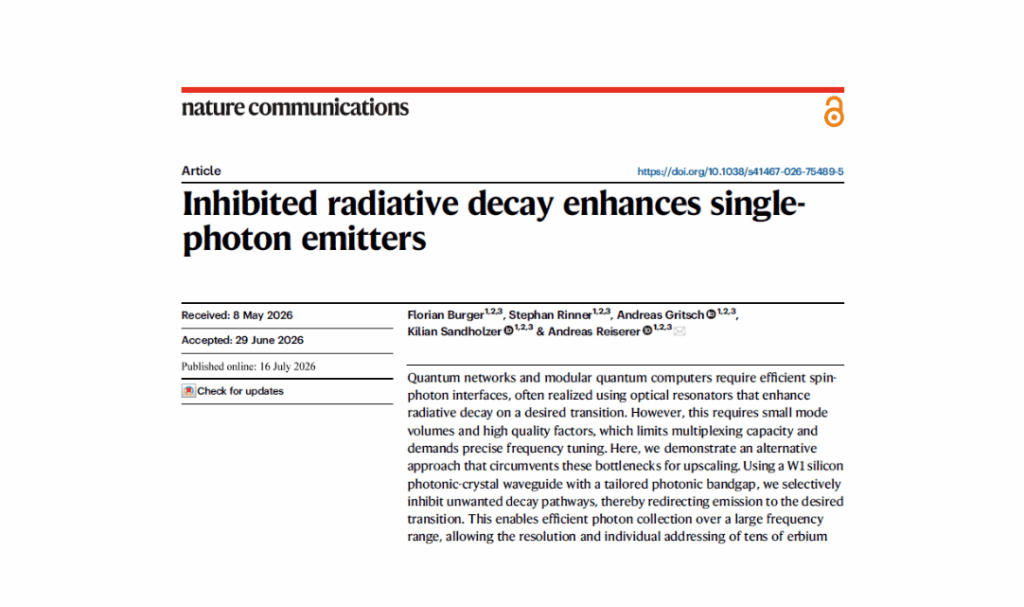
New Approach paves the Way for more efficient and scalable Single-Photon Sources for Quantum Networks – Quantum Networks and Quantum Computers require efficient single-photon sources to scale. Single photons can be generated in a controlled manner using solid-state emitters, but doing so is technically challenging. The emitters used for this purpose exhibit unwanted optical decay […]
High-Precision photonic Quantum Gates successfully cemonstrated
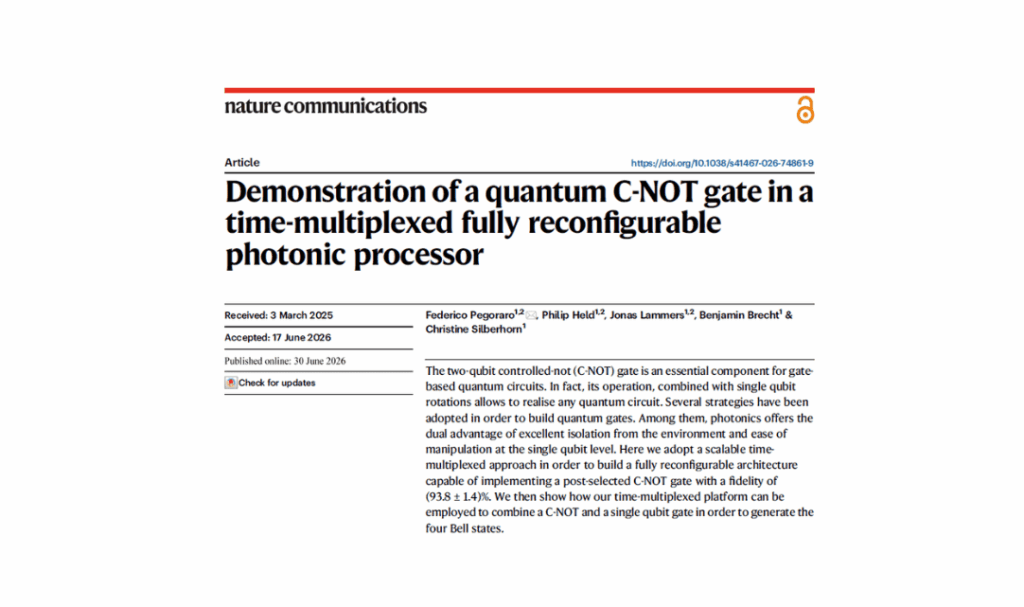
Time-multiplexed Photonics enables High-Precision Quantum Gates for universal photonic Quantum Computers – Quantum Computers promise to solve certain problems that are beyond the capabilities of classical computers. Photons are considered particularly promising carriers of Quantum Information because they are largely immune to environmental disturbances and can be precisely controlled at the level of individual qubits. […]
Electrical Control of molecular Spins successfully demonstrated
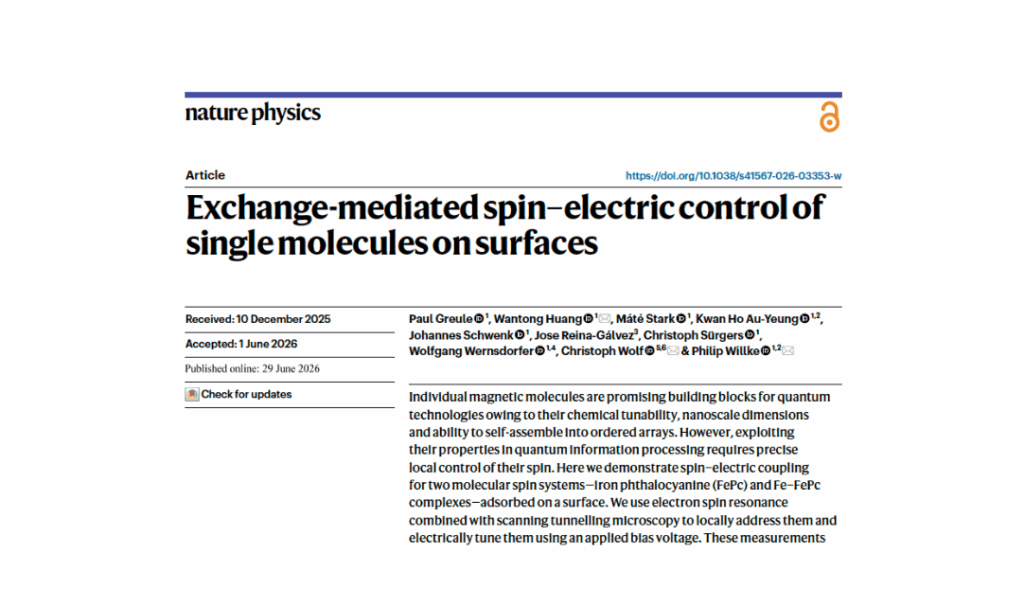
New Approach opens up new Possibilities for the precise electrical Control of electron Spins – Quantum Technologies are considered a key enabling technology for more powerful computers, secure communication, and highly sensitive sensors. Individual magnetic molecules are promising building blocks for applications in spintronics, Quantum Computing, and Quantum Sensing. Owing to their nanoscale dimensions, they […]
Paving the Way for Volume Manufacturing of Quantum Chips
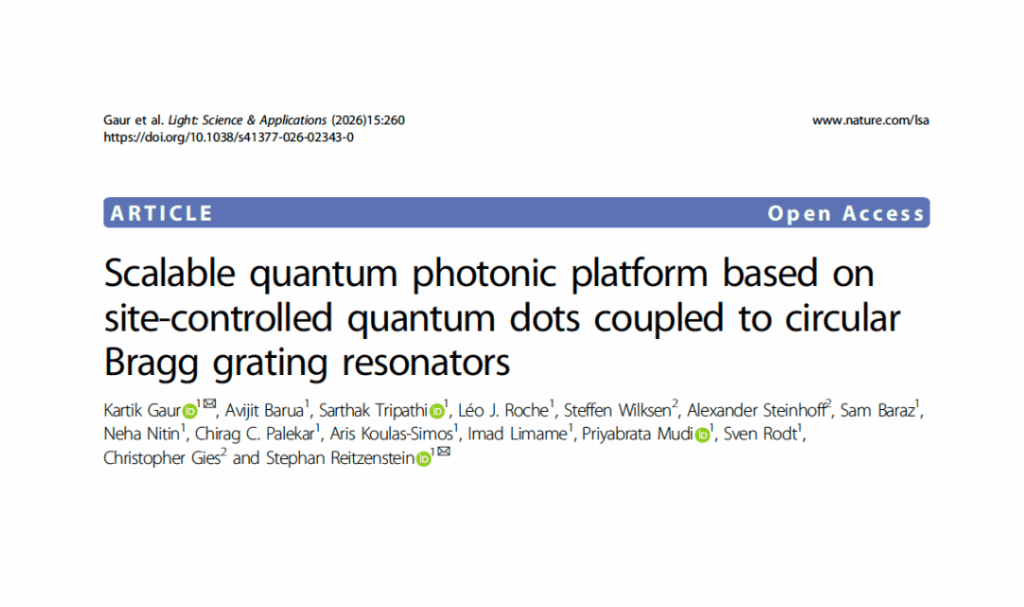
Precisely positioned Quantum Dots enable scalable and reproducible Integration of Quantum Light Sources on Semiconductor Chips – Photonic Quantum Chips are considered a key technology for future communication and computing applications. One of the major challenges in their fabrication has been that the required Quantum Light Sources – so-called Semiconductor Quantum Dots – form at […]
Observation of the Recurrence of Rabi Oscillations in Semiconductor Quantum Dots demonstrated
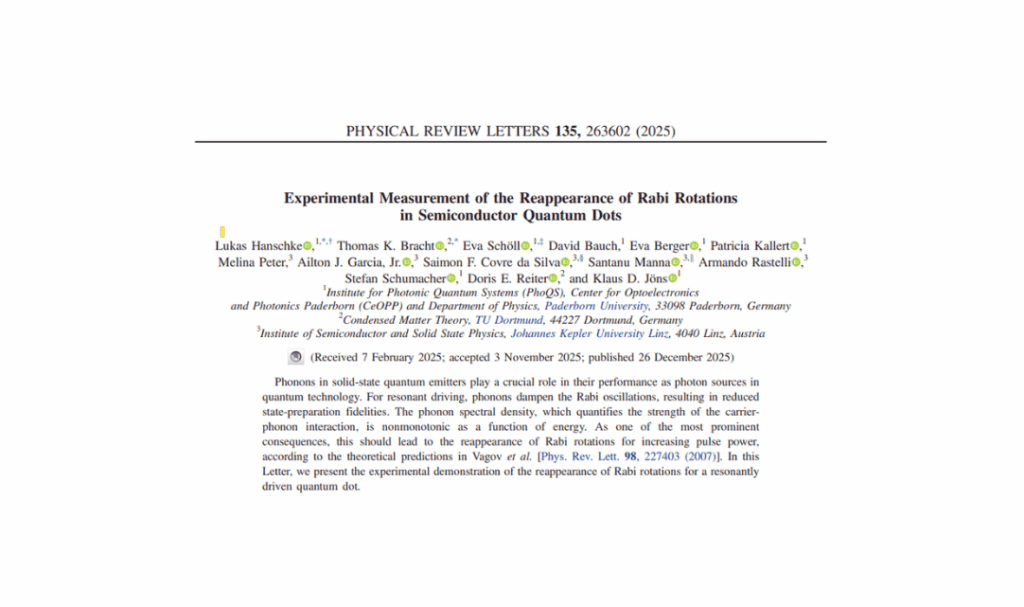
Experiment confirms, for the first time, the theoretically predicted Recurrence of Rabi Oscillations in Semiconductor Quantum Dots – Researchers from the QR.N consortium at the Paderborn site have successfully demonstrated the experimental observation of the so-called recurrence of Rabi oscillations in Semiconductor Quantum Dots. The phenomenon was already predicted in theoretical models in 2007 but […]
Efficient Source for polarization-entangled Photons in the Telecom C-Band
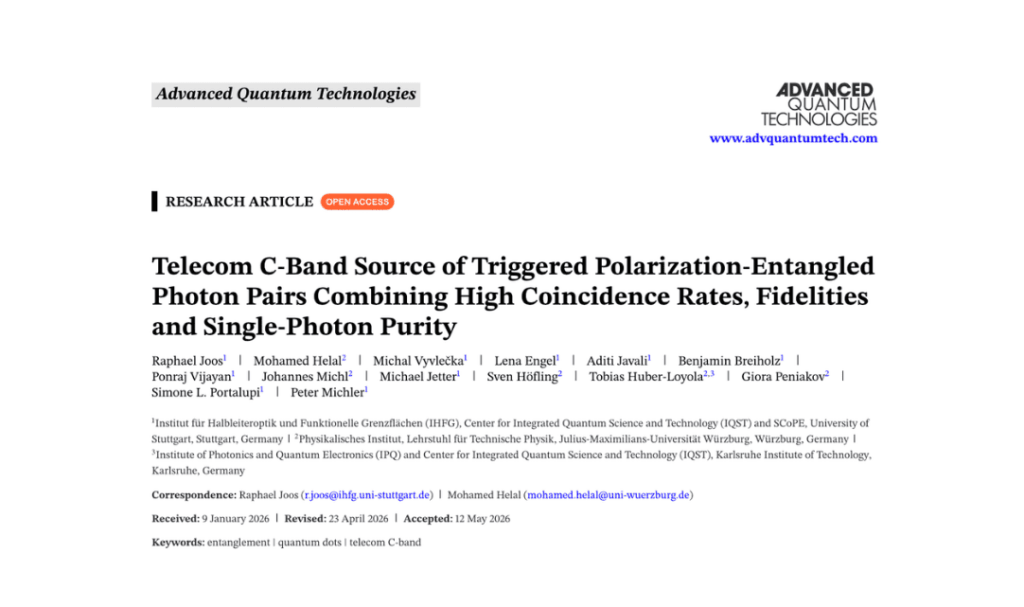
Quantum Dot Source generates triggered polarization-entangled Photon Pairs with high Coincidence Rates, Fidelities, and Single-Photon Purity – Many concepts for future Quantum Networks rely on the distribution of entangled qubits between spatially separated nodes. Photons are particularly well suited as information carriers, as they can transmit over long distances at the speed of light. Photonic […]
New Paper on Multiparty Entanglement published
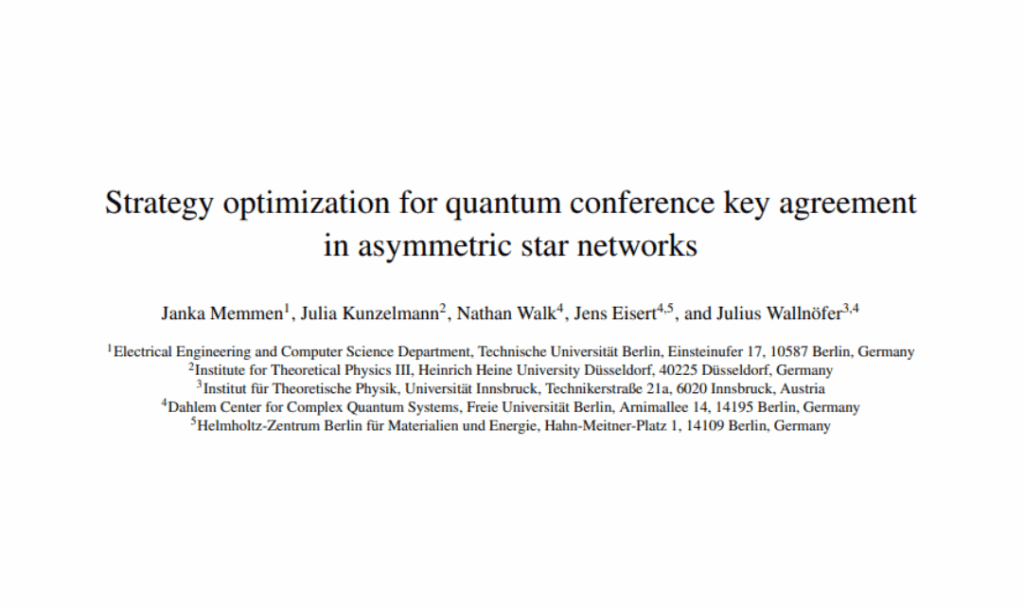
Experiment combines Multiparty Entanglement with event-ready Monte Carlo Simulations – In recent years, Quantum Networks have become a central research field in Quantum Communication. They enable, for example, the interconnection of future Quantum Computers and, in the long term, the so-called Quantum Internet. However, the technological challenges in realizing such networks are enormous. Among other […]
New Paper on Quantum Nonlocality in Triangle Networks
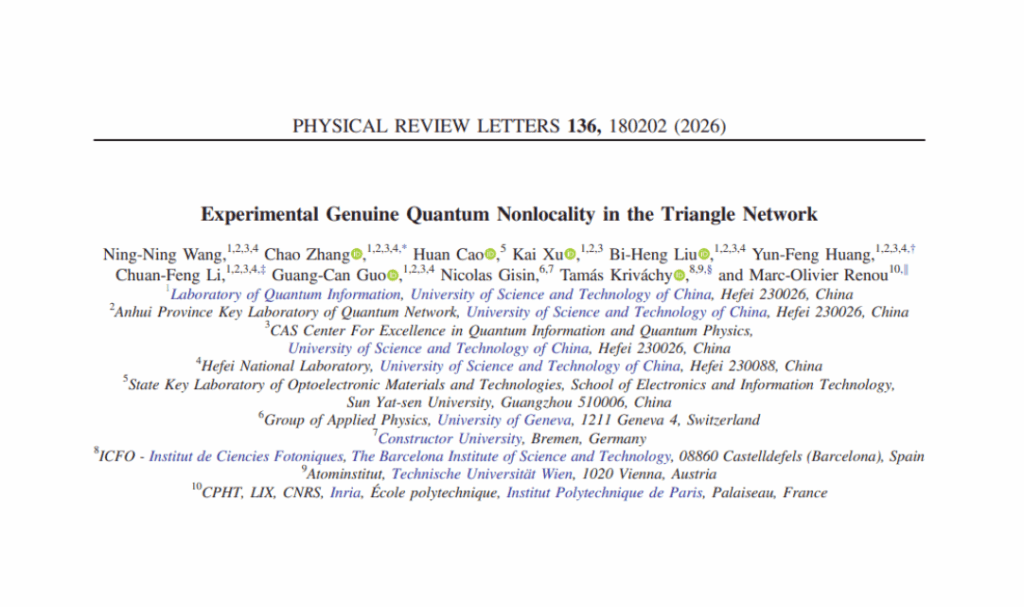
Experiment enables Exploration of complex Quantum Networks – Bell’s theorem, for which Alain Aspect, John F. Clauser, and Anton Zeilinger received the 2022 Nobel Prize in Physics, states that entangled particles remain connected even when separated by large distances. This phenomenon, known as Quantum Nonlocality, has for decades been regarded as a key demonstration that […]
New Article on Quantum Dot Devices
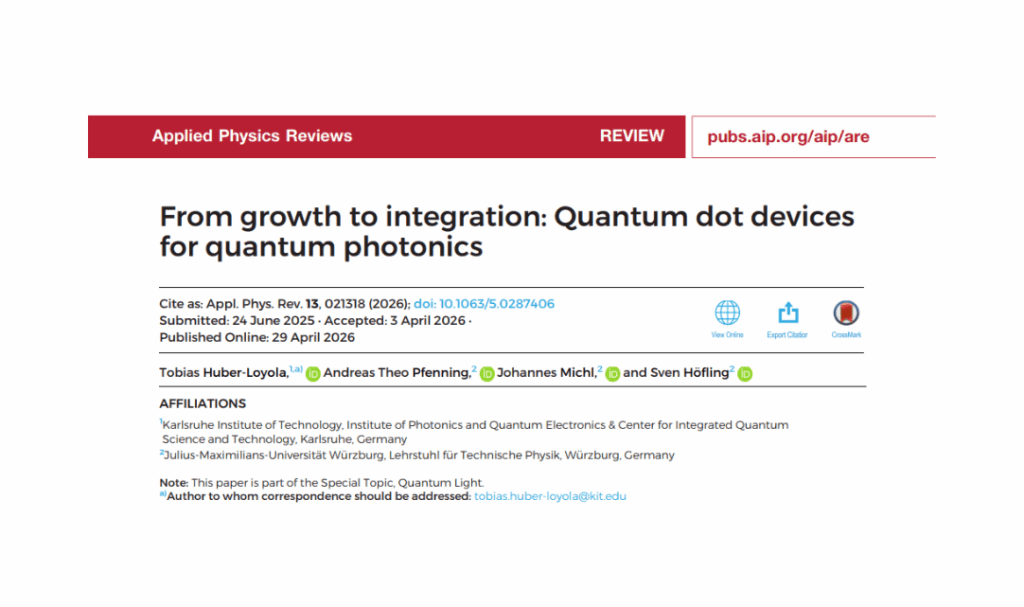
Review highlights Advances in epitaxial Growth, Telecom-Band Quantum Dots, and Nanophotonic Integration – Quantum Light Sources are a central building block of photonic Quantum Technologies that enable secure communication, Quantum Networks, quantum-enhanced sensing, distributed Quantum Computing, and Quantum Metrology. An ideal source should emit single photons on demand with high efficiency, high indistinguishability, and minimal […]